Tools of the Trade–Mirrors or Hammers?

On the heels of an amazingly extravagant weekend celebrating my daughter’s 5th birthday came blowing in the whirlwind of rejection. Don’t get me wrong—our weekend in Disneyland and California was fantastic; wonderful memories were created and I’m sure my daughter will remember it for the rest of her life–as will I. But the joy was tainted by a letter of “rejection” received just a few moments ago. And while I knew this was a possibility, and it’s not the first “rejection” I’ve received, it stings nonetheless.

Satan uses one rejection to bring up memories of others—people rejection, publisher rejection, performance rejection…etc. Feelings of rejection began early in my childhood. I was a heavy kid with bad acne so the attention I got was not the kind I wanted. I learned how to be a people pleaser very early so I could receive at least some positive reinforcement. Everyone likes to be happy, right? So I went out of my way to help the people around me be happy. It’s what I wished someone would have done for me.

All weekend long I had been thinking about a recent “people-rejection” situation in my life. I prayed over it continually and asked God to help me move past it. Just as I was getting “over it” I received a letter of rejection from a publishing company. Another gut blow.

Satan uses people and circumstances in our lives to assault us with a common “theme”. The theme assaulting me throughout my life is “you are rejected” and “you are not loved”. Even though I do my best to “live peaceably with all men”, trying  to recognize and acknowledge my faults, apologizing, trying to make amends, and continuing to encourage others, I find I am still misunderstood more often than not. My intentions are questioned and my motives are doubted. Through all of this is the same message, “you’re not good enough and nothing you do or say ever will be good enough”.  Over the years these feelings catapulted me into severe depression, physical self-abuse, and even attempted suicides.

I have since learned to ask God to show me how to deal with these feelings biblically (What can I learn? How can I allow God to change me through this situation?). I also ask God to prevent me from being used as an instrument of negativity in someone else’s life, because we are all being assaulted with a message from our Enemy. I do not want to be used by Satan to deliver a message to someone that they are not good enough, loved or appreciated, or whatever the message may be. I realize that many times I have been this “tool” and I continually ask God to open my eyes and eliminate these occurrences from my life.

Perhaps God is calling you to the same area of self-examination. You see an individual  or think of them and immediately have unpleasant thoughts. Maybe you think they’re out to get you, out to hurt you, or that they’ve rejected you. If you feel this way you may be dealing with un-forgiveness. Ask God to help you deal with these people as He would have; treating them as you wish they would treat you (Matthew 5-7).

And if you are battling rejection either relationally or circumstantially, ask God to help you deal with those feelings biblically. It may be tempting to retaliate against such people—wanting them to feel the way they make you feel by ignoring them, sending hate mail, “unfriending” them from social media and the like, but there is a reason God has allowed it and you will never grow spiritually in that area if you pretend like it isn’t a problem. When we fail to see people (or circumstances) through the eyes of Jesus, we will likely face similar situations again and again until we learn to deal with them appropriately. God never gives up on us or teaching us His ways, and I am thankful for that even if it hurts!

Whatever you are feeling today, whatever messages your Enemy has tried to send you or use you to send others, God wants to help you recognize and combat them with His word of truth. If no one else ever understands or accepts you, God does. He will never leave you, forsake you, reject you, misunderstand you, or ignore you.

So, the next time you’re tempted to react a certain way, ask God if you’re being His tool, or a tool of the Enemy in that situation or person’s life. What messages are you delivering with your words and actions? I recently read something and it’s a good thought to end on:

“If my life was the only source of God someone was introduced to, what conclusions would that person make of God’s character based on my reflection of Him?”

In other words, is my God a God who rejects, withholds love, criticizes, assumes the worst, and condemns, or is my God a God who forgives unconditionally, displays compassion, and gives grace? Am I a hammer or a mirror?

“The Lord is gracious and righteous; our God is full of compassion.” Psalm 116:5

“In the same way, let your light so shine before men, that they may see your good deeds and glorify your Father in heaven.” Matthew 5:16


Happy Accidents–A Lesson from Bob Ross

While most kids my age were watching the Simpsons and the Rugrats, as a young child I marveled at the skill of Bob Ross, a Christian painter who had a “how-to” painting program on PBS. I can’t imagine kids these days sitting around watching that type of show, but it was something I found inspiring.

He would take these globs of paint and turn them into glorious masterpieces of art. My favorites were always the oceans. The way he painted the waves, the shades of blue-green, the way he made the painting appear to glimmer—it was magnificent.

But more than all of those things I remember something he said while teaching the viewer how to paint. He said, “There are no mistakes, only happy accidents.” Sometimes he would purposely throw a stray mark in the midst of the beautiful picture only to prove his point. Skillfully working around it, blending it, and adding new colors he made it appear as though it was done on purpose.

Yesterday was a “Bob Ross” moment for me. A few weeks ago my digital camera took its last picture. Since then I had been using my phone to take pictures, but the quality was not the same. Knowing we were about to take a trip to Disneyland (we’re leaving tomorrow!) I was concerned about cataloguing the memories in my usual way—photos. My husband reminded me that we had an HD video camera which could also take pictures. So, I decided to figure out how it works and see if the pictures would be “acceptable”.

I took my daughter to AWANA and it happened to be a beautifully scenic evening with storm clouds glowing in the setting sun. I used the opportunity to snap some photos and quickly realized the quality of this HD camera was far superior to what I thought I had in my now broken digital camera. And then that phrase popped into my mind from nearly two decades ago, “There are no mistakes, only happy accidents.”

In that moment I was overwhelmed by the goodness of God. What I understood to be an inconvenience was actually a blessing. If my digital camera had not broken a few weeks prior, I would not have had the foresight to try the HD camera, and would have missed out on a glorious photo shoot—a divine photo shoot. Few things please the photographer in me more than an awesome sunset or scenic sky picture and those of my friends on Facebook will attest to that fact. But I have never had the privilege of capturing God’s beauty as I did last night. I have no words to express it. Every time I look at those photos I am in awe of my Savior. He planned that moment and in His great generosity He encompassed me with extraordinary feelings of wonder and worship.

Truly God plans all of our lives in such a way. There are no mistakes—even when we deliberately stray the canvas of our lives with ugly strokes of paint. The Master Painter simply takes His paintbrush and makes our mess beautiful. Beauty from ashes; this is the story of the redeemed. This is my story, my painting, and I am so grateful He takes the brush and continues to daily paint my picture with His infinite wisdom and care.

Lord Jesus, on my knees I confess my doubt, worry, anxiety, and disappointment—my unbelief. Help my unbelief and increase my faith ever more!

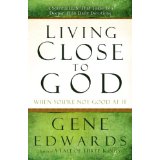
Living Close to God…by Gene Edwards

Living Close to God (When You’re Not Good At It) by Gene Edwards was written for the spiritually handicapped. Edwards describes the “spiritually handicapped” as those who struggle with intimacy in their fellowship with God, who falls asleep during prayer, who has a difficult time focusing during prayer, or someone who lacks the “spirituality” displayed in other Christians.

The chapters are short and the text is easy to read and understand—even a new believer would be able to grasp the exercises suggested. Edwards explains how learning to fellowship with God need not be limited to rigid devotional times, or lengthy eloquent prayers. One doesn’t need a college degree, a high-school diploma, or even be able to read. Edwards makes some intriguing points concerning the education level of most of Jesus’ followers in the Bible, notably that they were 98 percent illiterate.

Living Close To God makes several suggestions to aid the “spiritually inept” in their journey to experience Jesus and hear His voice. Consistent throughout the book was the importance of slowing down–slowing way down–and speaking words of praise to Jesus. Edwards also talks at length about repeating portions of specific Scriptures out loud to God, along with proclaiming one’s love for God, rather than focusing on prayers of request or personal need.  The author makes several useful suggestions that may help the reader “remember” to focus on the Lord for at least a few seconds every day.

I believe a new Christian would benefit most from this book, or perhaps someone who finds it easy to read/study things about God, but hasn’t developed an intimate relationship with Him. The person who seems to be too busy to slow down or the person raised in a legalistic environment who focused solely on “doing” may also find the tips in Living Close To God helpful.

The only problems I had with this book were of feeling pity for the author and the constant redundancy of the text. He stated many times how he had never been told how to experience Jesus on an intimate level while repeating the same “techniques” to aid in intimacy over and over again. I found it difficult to accept that he had never heard about praying Scripture before. Edwards also talked about the church not coming together to experience the presence of Jesus in this way, and I had to disagree with that. I’ve been to many churches that pray Scripture, encourage slowing down, being still, and listening to God.

Overall, I wouldn’t recommend this book to anyone I know mainly because my Christian friends already adopt the tips he suggested. As I mentioned before, however, it may be perfect for a new Christian or one who, like the author, has never been shown how to rest in God’s presence, listen to His voice, and spend time praising Him through word and song.

(I received this book for free from Waterbrook Multnomah Publishing Group and was not required to give a good review.)

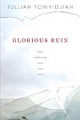
Glorious Ruin: How Suffering Sets You Free by Tullian Tchividjian

No one is exempt from suffering, whether physically, emotionally, or relationally. It matters not if a person is a Christian—everyone experiences suffering to some degree. No doubt suffering has been written about, studied, debated, and discussed for generations. Over time one may begin to wonder if there can possibly be anything new to say about it.  But Glorious Ruin: How Suffering Sets You Free by Tullian Tchividjian does exactly that. This may be one of the most important books a Christian could read in today’s publishing market. My view on suffering was challenged throughout this book, and by the end of it, I found myself deeply affected in a spiritually transforming way.

Glorious Ruin discusses at length two key issues: The Theology of Glory and the Theology of the Cross. Throughout the text Tchividjian explains the origins of both, as well as key differences between the two.

Glorious Ruin is brimming with powerful truth which provokes pause and careful contemplation in the reader. With brutal honesty, the belief system of the majority of modern Christians is challenged to go well beyond what is generally understood about suffering. Tchividjian also challenges the ideologies permeating from the Prosperity Gospel, Scientism, and Nihilism as well as skillfully working through the New Age “self-transformation” movement. He exposes the fallacy of Karma, and how most every Christian is tainted with the idea that “what goes around comes around”–whether they realize it or not.

“We communicate that God exists for our benefit, happiness, self-fulfillment, and personal transformation. Those aren’t necessarily bad things, and God isn’t necessarily opposed to them, but God in Christ cannot be reduced to a means to our selfish ends. He is the end Himself!” (pg. 47)

Christ cannot be reduced to a means to our selfish ends. He is the end Himself! <<<< Click to Tweet!

A tremendous amount of detail goes into studying the effects of moralizing and minimalizing suffering, namely within the Church community. We may think we are not guilty of such attitudes, but this book challenges thinking and promotes deep introspection on such issues. If we’re honest, we’ll admit we are at least tempted to rationalize suffering, or explain it, using the word of God. We tend to, at least subconsciously, feel the need to defend God’s allowance of certain tragedies. Glorious Ruin is not another book to offer reasons why a person suffers, it simply points to the Gospel repeatedly as not needing a defense or an explanation.

“The Gospel is not ultimately a defense from pain and suffering; rather, it is the message of God’s rescue through pain.” (pg. 38)

Unlike many Christian resources currently available, it’s clear Glorious Ruin was not written to promote a certain doctrine or theology, but focuses solely on the Gospel as it is written in the Bible, especially through the life and words of Jesus.

“What God pressed deeply into me is that there is no true, lasting hope outside of Him. Specifically, there is no true, lasting hope outside of the death and resurrection of Jesus Christ. I’m not talking about an explanation of what happened on Calvary—I’m talking about Calvary itself.” (pg. 150)

Perhaps one of the most poignant messages of the entire book deals with our inherent need to have things explained. Our natural tendencies are predisposed to asking the Why and How of our circumstances. The following quote hit home for me, personally.

“Explanations…are a substitute for trust, a red herring at best. God is interested in something much more powerful than anything information could ever produce. He is interested in faith.” (pg. 152)

I like to keep my personal “opinions” out of book reviews, keeping to the factual content of the book and letting the reader decide if its right for them, but this case proved impossible for me. I cannot withhold the deep impact this book had on my life and how the truth it contains applies to every living soul on the planet. If you think you know everything about suffering already, I plead with you to read this book. If you live a comfortable life, relatively free of what you consider suffering, I plead with you to read this book anyways—if not for yourself, for the people who walk in to your life who have suffered in ways you may not be able to relate to.

One thing you will not find in Glorious Ruin is an attempt to trivialize pain, or compare one person’s experience to another. Tchividjian rightly acknowledges that we all suffer in unique ways and God has a plan to set us free through that suffering, no matter what its form. Simply put, Glorious Ruin is a must-read Christian resource.

Glorious Ruin: How Suffering Sets You Free by Tullian Tchividjian is published through David C. Cook and is scheduled to be released on October 1, 2012.

(I received this book for review purposes only and was not required to give a positive review.)

Tullian Tchividjian is the Senior Pastor at Coral Ridge Presbyterian Church in Ft. Lauderdale, Florida. He is also the grandson of Billy and Ruth Graham. Tchividjian is a visiting professor of theology at Reformed Theological Seminary and has authored many books including Jesus + Nothing = Everything.

Dealing With Discouragement

**Published with Encourage 365, September 2012**

Have you ever been discouraged? For some of us we find ourselves so saturated in helping and serving others that our own encouragement tank needs refueling. But who is there to encourage us when our tank is empty?

Discouragement usually comes in two forms: circumstantial discouragement and spiritual discouragement…

Click HERE to read the rest of this article on Enocurage 365.

Nourishing Pathways (part 2)

**Published in The Christian Online Magazine September 2012 Issue**

This month concludes my interview with Rebecca Gertner. In case you missed the first half, you can read it HERE.

Nourishing Pathways to Health (part 2)

“Sometimes we think we can’t give up our fast food or soda pop or whatever it is we really, really like But God says with His help we can, if that’s what He wants us to do. I believe that God has a plan for each of us. What He wants me to do may not be what others should do. We need to pray about it, and no, it’s not silly to ask God which foods you should eat. He made you after all, so He knows more than anyone else knows what is good for your body and what’s not,” Rebecca explains.

The Gertner’s also decided to use organic produce to limit the chemical additives consumed in their diet. “Pesticides and other chemicals in our food do a lot to make us sick. It’s sad to say but there are food products out there that have more chemicals in them then actual food. If the chemical was designed to kill bugs, it will help kill us too. Buying organic produce is a good choice to make,” Rebecca said.

Recognizing the cost of eating healthy may appear daunting to many families, Rebecca still believes the physical benefits far outweigh the initial cost. Luke’s oncologist is also pleased, noting he has shown remarkable improvement. Rebecca learned how to save money by looking for great bargains, growing her own vegetables, and making products like laundry detergent and cosmetics at home.

For any family wanting to improve their health, Rebecca suggests incorporating small changes to avoid becoming overwhelmed. “Unless you have a medical crisis, there is no reason to make drastic changes that will stress you out. Start with something doable,” she says, “Like stop drinking soda. Next you could purpose to eat a vegetable at every meal. A great way to do this for breakfast would be making a green drink out of pineapple, mango and spinach sweetened with stevia. Keep adding one change on top of another and eventually you will be eating drastically different than you once were, but won’t go through the stress and drama. You will grow and adapt as you go.”

Rebecca and Luke’s three kids, Karsten, Faith Anne and Grace, have adapted well to the family’s diet changes. “They understand it will help their daddy get better and be better for all of us,” Rebecca says. “So far it has been great and I know God has given an extra measure of grace in that department.” She also noticed that as her kids’ diets improved, their overall health improved. Bruises and scrapes healed quicker.

“We view this as a lifestyle change,” Rebecca says, “Mostly so we can be realistic about it, but also because there is no known cure for the cancer Luke has. It would be a shame to work hard to get well, only to have a relapse simply because we started eating the way we used to again.”

Despite the uncertain future, Rebecca’s attitude is hopeful as she follows God’s plan for her family’s health. “In the book of James it talks about how when we know what’s right but choose not to do it, we are sinning. I have applied that verse to this area of my life. If I know I should be eating healthy but consistently make poor food choices, then I am sinning. I am not saying that I don’t eat sweets or French Fries every now and then, but on the whole, I should be eating what is good for my body, not just what tastes good. Anytime we purpose to do something healthy, we benefit. Whether it’s more energy or less illness, it’s a benefit. Everyone benefits from eating a healthy, nutritionally solid diet.”

© Rebecca Aarup

Pleasing God by R.C. Sproul

A war is raging within us, a deadly triad of enemies battling our spirit to keep us from pleasing God. We want to do what is right, but at the same time our deep self-rooted desires pull us away from what is pure, wholesome, and altogether pleasing to our Heavenly Father. Over time we may find ourselves discouraged and distraught over our inability to live as God called us to live. If this war rages on, ignored, we will never live up to our full potential honoring God through our lives.

Pleasing God by R.C. Sproul is a worthy spiritual resource for anyone who desires to align their life with the Word of God. Readers will walk away with a clear understanding of what is expected from those who would claim to be a Christian.

“True living flows out of right thinking…how we think about God is the most vital influence to how we respond to God.” (pg. 185)

What does right thinking look like? What does it mean to grieve the Holy Spirit? What enemies are at war within us? What evidence can we look for in our lives to show we are, indeed, pleasing God in all we do?

These questions are answered along with many more. Sproul also touches on various issues such as conversion, forgiveness, pride, integrity, laziness, carnal Christianity, doctrines of faith and many more key subjects. Simply stated, Pleasing God is an all-inclusive guide through the process of sanctification in the believer’s life.

Of considerable interest is Sproul’s extensive work on the subject of guilt scattered throughout the text. He discusses false guilt, guilt from sin, as well guilt that results in physical and psychological disease. Many people struggle with guilt, and anyone could benefit from the application of truth concerning guilt presented in this manuscript.

Pleasing God consistently points readers to the Word of God—knowing it as well as believing it. Without knowledge of the Bible, a person cannot understand how to please God.

“Consciousness involves knowledge. Before we can willfully do what God commands and what pleases Him, we must first understand what God requires. From the law comes a knowledge of sin (Rom. 3:20). But from the law also comes the knowledge of righteousness (Rom. 7:12; Psalm 119).” (pg. 186)

Pleasing God is not overly-complicated or lengthy. It masterfully presents truth in an easy-to-understand manner. Readers will walk away from this book with a renewed motivation to actively pursue God, put Him first, know His Word more, and persevere in pleasing God in every aspect of life.

Pleasing God is published by David C. Cook and available for purchase on September 1, 2012.

R.C. Sproul is the founder and chairman of Ligonier Ministries and serves as the senior minister at Saint Andrew’s, a Reformed congregation in Sanford, Florida.  Sproul has written dozens of books including The Prayer of the Lord, The Reformation Study Bible, Chosen by God, and The Truth of the Cross.

(I received this book for review purposes and was not required to give a good review.)

Many are the Plans…

“Many are the plans in a person’s heart, but it is the Lord’s purpose that prevails.” Proverbs 19:21

Many are the plans…

I’ve waited patiently for three years (ok, not so patiently) to enroll in Bible college. I’ve wanted to transform myself from the uneducated hack to the educated hack. It’s taken this long for the finances and timing to be just right. Finally I was able to enroll at Liberty University in a two-year program to receive a diploma in Biblical studies; I also decided to take a hermeneutics elective. Once the transaction was completed, confirmation in hand, I was overwhelmed with excitement.

Then the door-bell rang.

Oh right, the home-school curriculum for my daughter arrived.

As I pulled out the books, manuals, instructions, and lesson plans I was overwhelmed. “Many are the plans” sang ominously through my head. Indeed. I was planning on spending the day finishing my other year-long course in journalism. I had one lesson left and was super-pumped to complete it. Searching through the instructions, guides, manuals and products-to-buy lists included in the box of curriculum materials, I realized it would take at least 3-5 days to sort through it and develop an organized lesson plan. Whoever thinks home-schooling is easy, or lazy, or whatever, they are sadly mistaken. It’s like being a “real” teacher minus the pay (when done appropriately).

Many are the plans…

On top of home-schooling and being a student myself, I was reminded of all the things I still had “to do”. The list was endless.

A 45,000 word manuscript to finish before Novemeber’s conference; 6 books to read and review in the next month; articles to write for two different websites (besides this blog); a backyard landscaping project; church ministries and other activities…my head was spinning. Oh, and I almost forgot, there is approximately 500lbs of dog poop (a rough estimate) in the yard calling out to me, “Scoop! Scoop!”

So so so many are the plans…

But—it is the Lord’s purpose that prevails. I can make all the plans I want, I can sign up for every ministry, activity, conference or course but it is only through God that my plans prosper. If indeed they are HIS plans. Otherwise, I don’t have a prayer.

So, this morning I found myself taking a step back. Instead of attacking my “to-do” list, I listened to Psalm 118-119 on audio, read from Isaiah, and spent some quiet time with God asking Him what HIS plans were.

My new plan consisted of listening to the Holy Spirit as he guided each step of the day. I pray the Lord’s purpose prevail in each moment of each day of my life for His glory and my freedom.

Lord, I want your plans and purposes for my life. Thank you for providing wonderful opportunities, answering prayer, and giving me the desires of my heart. Keep my eyes focused on you every minute of every day. Let your plans alone prevail over my life.

God’s Love by R.C.Sproul

Who can begin to comprehend the depths and wonders of God’s immeasurable love? R. C. Sproul attempts to shed light on what is arguably the most misunderstood of all God’s attributes–love.

“Whatever God’s Love is, it is not exhausted by our concept of it. It transcends our best efforts to describe it. It is higher than our loftiest notions of it.” (God’s Love, pg. 29)

God’s Love is a penetrating theological read which challenges the intellect on a variety of issues and seeks to answer key questions: What is love? Is a loving God also a wrathful God? How is God’s love displayed through redemption, adoption, and election?

R. C. Sproul devotes an exceptional amount of time interpreting the doctrine of election. Lengthy Scripture quotes are also extensive throughout the text, eliminating the need to stop reading, pick up a Bible and look up references for clarification.

Of particular interest is the detailed exposition of the “love chapter”, 1 Corinthians 13. A great deal of God’s Love unravels the depths of truth woven throughout this often misquoted and misunderstood passage of Scripture. Readers may find this portion of text to be uniquely beneficial.

God’s Love is not a book designed for quick reading, or a cursory glance at the attributes of God. God’s Love provokes deep thought on deep doctrines and may be difficult to understand for a new Christian, or one who has not studied much of the Bible.

God’s Love is published by David C. Cook and available for purchase September 1, 2012.

Dr. R. C. Sproul is the President of Reformation Bible College and the Founder and Chairman of Ligonier Ministries. He has authored over 80 books including The Holiness of God, Chosen by God, and The Truth of the Cross.

A Little Inspiration from Isaiah

“Don’t fear anything except the Lord of the armies of Heaven! If you

fear Him, you need fear nothing else.”

Isaiah 8:13


“See, God has come to save me! I will trust and not be afraid, for the

Lord is my strength and song; He is my salvation. Oh the JOY of

drinking deeply from the Fountain of Salvation!”

Isaiah 12:2-3

“But the Lord of Hosts is exalted above all, for He alone is holy, just,

and good.”

Isaiah 5:16