Book Review: All in Perfect Time by Cat Hatchett

allinperfecttime1All in Perfect Time: Miraculous Personal Stories by Cat Hatchett is an inspirational collection of stories from people of all different faith backgrounds, nationalities, and cultures.

Have you ever wondered if there was such a thing as “divine appointments”? Or maybe you believe everything happens by chance? No matter what your faith, through the words of this book you will be encouraged to believe that something exists beyond yourself and your immediate circumstances. That we are all here for something greater than we could have possibly dreamed up for ourselves.

One of my favorite aspects of this book is that each story is short and simple. The book is easy to pick up and read here and there, and does not require any sort of time commitment. It would make a great gift book for sure, whether you’re a Christian or not. It would be difficult not to be spiritually uplifted and inspired through the amazing experiences recorded in this book.

I recieved All in Perfect Time as a gift from a friend while I was going through some trying circumstances, and I found the stories within to be very encouraging and uplifting to my spirit. I was never asked to give a review or even share it with anyone, but chose to do so because I love the heart and ministry of the author and wanted to share that with you all. You can purchase the book on Amazon HERE.

__________________________________________________________

Cat Hatchett is the author of an inspirational autobiography titled “Walk Right Through It” written after the devastating loss of both of her parents in 2006. She started the Kingdom Connection fellowship in the San Fernando Valley, a vehicle to bring people in the community together for prayer needs and mutual support. You can visit her website HERE and follow her on Twitter HERE.


So, what is YOUR word?

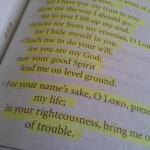
psalm143“What will you do?”

As I’ve heard sermons, read books, and sat through lectures throughout the year, I’ve heard the voice of the Spirit resounding loud and clear, “So, what will you do about it?” God has strategically batted that ball back to my side of the net over and over—spurning me to embrace an active faith, and it makes me uncomfortable. But then I remember a prayer I uttered, albeit not well-thought through at the time, for God to make me uncomfortable. Really, that prayer should be right at the top of the list of “things you don’t ask God”, right behind praying for patience or a spirit of forgiveness. Well, I’ve learned my lesson—God answers prayers for sure, especially the character building ones.

At the start of 2012 a friend of mine posted a blog about a challenge (read it here: MY One Word), a challenge to ask God about what “word” to focus on for the following year. That sounded neat, so I gave it a go. I cheerfully got on my knees and asked God what my special word for the coming 2012 year would be, I anxiously listened, hoping to hear prosperity, success, purpose, or anything along those lines. Instead, after a few moments of silence, I heard “perseverance”.

“Um, Lord, really? I mean…really?” Some of my friends were getting words like “go” and “action” and I got perseverance? I didn’t like it; I wanted to take back the prayer. What was God thinking, anyways? I had always been somewhat known for starting things and losing interest over time, eventually abandoning the project or idea. But looking back on 2012, I can see how God used the trials of one of the most difficult years I have faced to break my pride, provide me with ultimate spiritual freedom, as well as teaching me self-discipline and yes, perseverance.

I would be lying if I said I wasn’t happy to start a new year, because even though it’s just another day on the calendar, somehow turning the page and writing a new number (2013) just feels like a fresh start. I’m looking towards 2013 with great expectation—expectation in God’s revealed will (HIS Word) and not my own clever ideas. I still haven’t prayed about the new word for next year, but I’m not as scared about it as I was last year. Looking back I know that no matter what, God knows what He is doing and I can really, in fact, trust Him in all things, even the hard, painful, and uncomfortable things. That no matter what the situation, His character is constant, even if I’m not feeling like it is.

His character is constant, yes, perhaps the biggest lesson I learned this year. My character? Not so much. Which is why the prayer, “Lord, change me” has been cried out more times than I can accurately recall.

So, mingled in with words like illness, death, betrayal, loneliness, slander, hatred, consequences, loss, depression, despair, relapse, and uncertainty have been the words of truth—healing, restoration, freedom, hope, peace, purpose, fulfillment, grace, mercy, understanding, and love. All of the awfulness has actually taught me how to be an optimist of sorts. An optimist in God, not in myself. An optimist in His character, not in my ability.

I’ve asked, He has answered, and none of His responses were as expected. Through all of this I am learning that maybe, just maybe, He really does know better than I do.

“Teach me to do your will, for you are my God; may your good Spirit lead me on level ground.” Palm 143:10

What theme has God brought to your year? What “lesson” have you learned through trials or blessings? Post your comment here or join the discussion on facebook.

__________________________________________________________

profilepic3Rebecca Aarup is an author and freelance writer. She is also a health columnist for The Christian Online Magazine, a contributing writer for Encourage 365, creater of S.E.R.V.A.N.T. Sisters women’s ministry (online), and has written devotionals/studies/articles for a variety of publications. She just released a new Bible Study The Word: Six Lessons from Psalm 119 which is available as a free download on her website or in print form from Amazon. Beyond writing, Rebecca is a wife, home-schooling mom, and Bible student at Liberty University. She lives in Glendale, Arizona with her husband Chris and 5 year old, Samantha.  You can read more from Rebecca by subscribing to her blog (it’s free) and following her on twitter and facebook.

A United Heart

Lou Ann stopped by my blog a few days ago and in turn, I visited her blog. I love her heart, her mission, and her writing! So, I am sharing it with you. Please read her short devotional on what it means to have a “United Heart”–obviously a subject near and dear to me. Enjoy!

Teach me thy way, O LORD;
I will walk in thy truth:
unite my heart to fear thy name.
(Psalm 86:11)
Most of this verse is simple in language and easy to understand. I stumbled a little at the word unite. What does it mean here? I looked up the Hebrew equivalent, and it means “unify; join.” Okay, but what is a unified heart or a joined heart? Commentators have several ideas about this word in the context of this verse. It can mean a “completely dedicated” heart or a heart with “undivided loyalty.” I thought of “single-heartedness,” something like single-minded.
In any case, the psalmist profoundly states his desires. This verse is his prayer:
            Teach me Your way.
            I resolve to walk in Your Truth.
            I want a heart that is wholly dedicated to respecting and following You.
Are the psalmist’s desires our desires?
            Do we really want to be taught what God wants us to do?
            Have we ever resolved (promised ourselves) to walk in the Truth (the Bible)?
            Do we have an “undivided” heart to respect and follow God?
In my counseling experience, I have found many women who want to do right. “Oh yes, I want to.” But, they don’t really want to be taught—not by God and not by anyone else either. They have never made a conscious decision to follow and know Truth. They don’t have time for God’s Word, don’t pray, and then they wonder why they’re having such a hard time grasping Truth. They have divided hearts. Part of them wants to do what everyone else does—follow “fun.” And, part of them really wants to follow God, but they’re not fully dedicated (united hearted) to it. Unfortunately, these ladies will always flounder spiritually.
I’ve also counseled women and girls who would say a hearty Amen to the psalmist’s three desires in this short verse. They are growing and changing. And they’re some of the happiest people I know.
May we all have undivided hearts!
Lou Ann Keiser is a missionary pastor’s wife with almost thirty years of ministry experience. She loves Bible study and people. Lou Ann is the mother of two married children and a grandmother. She lives in a quaint little town in Europe.
Please visit her blog: In the Way
**If you or anyone you know enjoys writing, www.servantsisters.org is currently looking for new writers to contribute devotions or photos with inspirational thoughts. You can check out the writer’s guidelines: Write For Us**

You Think YOU Have Waited a Long Time?

“[Elijah] went a day’s journey into the wilderness…and he requested that he might die; and said, ‘It is enough now, O Lord, take away my life.’” 1 Kings 19:4 (KJV)

Elijah was one of the greatest prophets who ever lived, yet even he had unanswered prayers. After being assured by Jezebel that his life would come to an end, Elijah ran for the hills. He was so weary, so discouraged, he was ready to throw in the towel, give up the fight, and be at rest in the arms of God.

God did not see fit to answer this prayer, nor has He ever answered it. The book of Second Kings records how Elijah was taken by a flaming chariot into heaven without experiencing the physical death he had wished for.  So—end of story, right?

Wrong.

Skip ahead a few centuries and we find in Revelation 11 that God has remembered Elijah’s prayer and answered it.

“And when [the two witnesses] have finished their testimony, the beast that ascendeth out of the bottomless pit shall make war with them, and shall overcome them, and kill them. And their dead bodies shall lie in the street of the great city…” Revelation 11:7-8

And who are these two witnesses? According to Malachi, one of the witnesses is Elijah.

“Behold, I will send you Elijah the prophet before the coming of the great and dreadful day of the Lord: And he shall turn the heart of the fathers to the children, and the heart of the children to their fathers, lest I come and smite the earth with a curse.” Malachi 4:5-6

Elijah’s prayer was heard and will be answered—he only needed to wait a few thousand years. I don’t know about you, but I get antsy after waiting a day or two for an answer to my requests. In fact, just two weeks ago God answered a prayer I had been bringing before him for over a year. It happened in a most unexpected way (which seems to be the case most often), and even today I marvel at the circumstances surrounding His answer. But there is a big difference between one year and a thousand. I can’t say for sure, but I probably would have given up believing a positive outcome was possible if a few more years had passed.  And yet, I have other requests that have been waiting for an answer for many years. Will I choose to trust God?

Understanding Elijah’s plight gives me great hope. God does not forget my prayers, even if it seems like He has decided not to answer them. The fact is, I only see the steps in front of me but I don’t see (or understand, usually) the big picture. Maybe my unanswered prayer has a greater purpose for another time—perhaps even decades or centuries from now.

Today I will continue to lay my requests at His feet, knowing He hears, He cares, and He will answer one way or another in His perfect time.

“I have called upon thee, for thou wilt hear me, O God: incline thine ear unto me, and hear my speech.” Psalm 17:6

Six Signs of a Spiritually Divided Heart

**Originally Published on Encourage 365, October 1st, 2012**

A cursory glance through Psalm 119 reveals the heart of an author wholly enveloped in the words of God. It is blatantly obvious the Psalmist not only read the word of God on a regular basis, but lived its truth in his every-day life. Psalm 119 provides all the answers we could ever hope for in regards to approaching the Bible with an undivided heart.

So how do I know if I’m seeking God with all my heart? How do I know if I love God with all my heart? How do I know if I believe God with all my heart? How do I determine if my heart is divided or united to fear God’s name in truth (Psalm 86:11)?

1. A spiritually divided heart is emotionally unstable.

“Blessed are they who keep his statutes and seek him with all their heart.” (Psalm 119:2) The Hebrew word for “blessed” in this passage is ‘esher (eh’-sher) which translates “happy”. Blessed does not mean wealthy, successful, powerful, popular, or prominent though it may certainly be a blessing to have those statuses. A divided heart is revealed in a saddened or discouraged countenance. Is my life characterized by happiness and peace or worry and confusion? Am I tossed into the depths of despair through every undesirable circumstance or have I entrusted my innermost source of happiness to God’s word? The only way I can have lasting happiness is to walk by and believe God’s word of truth.

2. A spiritually divided heart is wandering.

“I seek you with all my heart; do not let me stray from your commands.” (Psalm 119:10) God’s word is not a list of rules keeping me boxed in under the heavy thumb of dictatorship. God’s word was inspired and written for my greatest good. The Bible clearly outlines and defines what path to travel, what attitude is appropriate, and what ministries to pursue. When I start to rely on my own reasoning, logic, and understanding, I stray from God’s perfect knowledge of His creation—me.  My heart is divided when I fight against the truth of God’s revealed word and willfully or ignorantly choose my own path.

3. A spiritually divided heart is selfish.

“Turn my heart towards your statutes and not toward selfish gain. Turn my eyes away from worthless things; preserve my life according to your word.” (Psalm 119:36-37) Left to my own devices I am bent towards selfishness. When I argue with my spouse over where to eat dinner I put my needs in front of his. When I am offended by the opinions of others, threatened by the status of a peer, or hesitant to give of my abundance to someone in need, I am selfish. I have strayed from God’s word and will and allowed my flesh to take over. My heart has been divided. I have failed to esteem others as better than myself (Philippians 2:3).

4.  A spiritually divided heart is inconsistent.

“This has been my practice: I obey your precepts.” (Psalm 119:56) Can I truthfully proclaim that I obey God’s word without falter every second of every day? Not a chance. However, the undivided heart, or the heart walking through life believing God’s word, will be swayed towards obedience. Willful rebellion will be the exception, not the rule. When my daily practice is devoted to knowing and following God’s word, my heart is united in truth.

5. A spiritually divided heart is malnourished.

“How sweet are your words to my taste; sweeter than honey to my mouth!” (Psalm 119:103) When I am hurt, angry, confused, or otherwise afflicted, where do I turn for guidance and comfort? Do I seek the opinions of friends, family, pastors, and teachers first or do I seek the counsel of God? The more of his words I consume, the more nourished I will be. When I neglect his guidance and first seek help from human sources I am left hungry and malnourished. If I don’t know the word of God, how will I know if the advice I’m given is biblical? Like the prophet Isaiah so eloquently stated: “Why spend money on what is not bread, and your labor on what does not satisfy? Listen, listen to me, and eat what is good and your soul will delight in the richest of fare.” (Isaiah 55:2)

6. A spiritually divided heart is fearful.

“I will speak of your statutes before kings and will not be put to shame, for I delight in your commands because I love them.” (Psalm 119:46-47) If my Monday through Saturday life does not line up with my Sunday life, I should be afraid to speak of my faith. Without a living, active gospel displayed through my life, I will be put to shame when I witness to others. How can I preach to someone when my life is the opposite of my message? When I hear of terminally-ill loved ones, if unsure about their eternal destiny, I am motivated to witness to them before it’s too late. But was I motivated to witness before I knew they were sick? Shouldn’t every day be an opportunity to love God, live God, and display God in everything I do?  If I am not displaying the love of God by witnessing to my lost friends and neighbors, I am living in fear. I want my life to always back up my message and never distract from the wonderful, freeing truth of the Gospel of Christ.

Every time I read Psalm 119 I am reminded to check my heart-status. Am I whole-heartedly seeking God and his word or am I offering up only the pieces I prefer? Can I stand beside the Psalmist and before God, unashamed and fully exposed and still declare, “My soul is consumed with longing for your laws at all times. Your statutes are my delight and I have chosen the way of truth.” (Psalm 119:20, 24, 30) That is my desire; to live with an undivided heart wholly united with God’s word.

What Does it Mean to be a “Healthy” Christian?

**Published in The Christian Online Magazine, October 2012**

What Does it Mean to be a “Healthy” Christian?

You can’t go very far without hearing the word “healthy”. It’s on every newsstand, magazine cover, and diet book. Ironically, these publications will claim to know the secret to becoming healthy, yet none of their articles will point to the same solution. How is a person supposed to know what direction to take?

As Christians we are admonished not to follow the patterns of the world (Rom. 12:1-2), but that doesn’t mean we shouldn’t concern ourselves with our physical health. Yet even more important than our physical health is our spiritual health. The more “in tune” we are to God’s Word, the more motivated we are to make wise decisions concerning our physical bodies. Physical and Spiritual cannot be separated. We are to honor God with our whole bodies, not just the pieces we want to give Him.

So, that leads us to the question—as a Christian, what does it mean to be “healthy”? I recently posted this question on Twitter and received some responses.

@Gregparker16 tweeted: “Being on your knees in front of the Lord every night.”

@Hasten_Home tweeted: “Functioning in full contact & strength in the capacity God intended.”

Both of these answers are excellent. But let’s take it a step further and find out what the most important Book has to say. After all, is there any better advice then what is found in the Word of God?

3 John 1:2 “Beloved, I wish above all things that thou mayest prosper and be in health, even as thy soul propsereth.” (KJV)

The best way to understand any verse is to go to the source of writing, that is, the original language. So much gets lost in translation. The Greek and Hebrew languages are very complex and many times a single word is given numerous meanings. So at all times one must consider the context of the passage when interpreting Scripture responsibly.

What we read in 3 John 1:2 is a typical greeting among brethren in the Church. Obviously they wished each other well, just as you or I would ask someone, “How are you?” Greetings such as these were acts of courtesy as well as genuine concern. What I found particularly interesting in this passage was the meaning of “health”. The Greek word “hugiēs” (pronounced hoog-ee-ace) translates: “uncorrupt” or “true in doctrine”. It also means “safe and sound” or “whole”.

And here lies the answer to our question. As a Christian, to be “healthy” is to be whole in spirit (including doctrine). Wholeness begins in our hearts.

We see this same concept displayed throughout Isaiah and Jeremiah. Several times the word “health” is used, and each time it refers to a spiritual wholeness for the sinful nation of Israel (see Jer. 30:17; 33:5-6, Isa. 58:8).

The most important health concern we have involves our spiritual health. A spiritually healthy, balanced Christian will make wise choices in the world, including that of food, activity, and finances.

God is in the business of restoration (wholeness). He often allows brokenness to bring healing—all to the glory of His Name. Psalm 51:8 “Make me to hear joy and gladness that the bones which thou hast broken may rejoice.” The Hebrew word for “bones” in this passage is not referring to the literal bone matter holding David together, but rather the spiritual matter. Translated from Hebrew the word “bones” means “substance of life”—in other words, his spirit. God allowed David to experience spiritual brokenness so He could bring David through the valley of repentance towards the mountaintop of restoration.

Do you want to be a healthy Christian? It begins with God’s word–obedience to it and cleansing by it. We don’t drive a car without first using our minds to get in the car, turn on the engine, and press the gas pedal. Likewise, we can’t expect to make wise life-choices in any area if our minds are not aligned with the absolute truth of God’s Word.

“I have chosen the way of truth…I will run to the path of your commands, for you have set my heart free.” Psalm 119:30, 32 (NIV)

© Rebecca Aarup

A Jesus Diet?

I didn’t grow up in a “fasting” household. I knew about fasting, but had never seen anyone practice it, much less preach about it. As an adult I’ve only been led to fast a handful of times, once for 3 days, and all the other times for only a day. A few days ago a friend of mine posted a link on her Facebook page to this site: www.40daystosaveamerica.com and I clicked on it. Immediately God impressed upon me the desire to do a 40 day fast while not only praying for our nation before the elections, but seeking a personal spirit of revival and repentance.

No matter what comes of the elections, or what side of the street we stand on concerning politics, I think we can all agree that the world needs revival—Christians need revival. This is something we can all be praying for in our own hearts and the hearts of our brothers and sisters.

Not everyone will be called to do a 40 day fast, and many will feel led to give up something other than food. I know some who are doing a Facebook fast, a coffee fast, or giving up other things and exchanging those wants for prayer. Fasting or not, earnest, sincere prayer is essential for the Christian.

And just in case I was feeling like maybe I heard God’s voice wrong (or even hoping I heard wrong!), I received the following devotional in my email this morning, which happens to be day #1 of my fast. It spoke directly to me, and I know you’ll be blessed by it as well. No matter what you choose to do for the next 40 days, I hope you will dive deeper into prayer for whatever God lays on your heart. This time will certainly not be wasted, as we know He saves every prayer for a future sacrifice of worship (see Every Prayer Uttered).

Blessings, my friends!

~Rebecca


A Diet in Jesus’ Name?
By Skip Heitzig

We focus a lot on food. Eating is one of our favorite pastimes, and we talk a lot about food. There are even place names that are foods. There’s Two Egg, Florida… Bacon, Delaware… Pancake, Texas… Hot Coffee, Mississippi.

One thing you don’t hear a lot about today is fasting. But did you know the Bible mentions fasting more times (nearly 60!) than even the “important” subjects like baptism?

Fasting is not a “diet in Jesus’ name.” It’s not a way to lose weight and be blessed. Fasting is done for spiritual motives.

In the Bible, fasting was done in times of danger, like when Esther was preparing to approach the king of Persia (see Esther 4). It’s a part of repentance: Both Daniel and Ezra fasted in response to the sins of the people, and the king of Nineveh ordered a fast when that city repented (see Jonah 3). Fasting was done in preparation for an important task or ministry. Jesus fasted 40 days and nights before He began His preaching ministry, and the apostles fasted before they sent Paul and Barnabas out (see Acts 13).

Fasting is a time when we take the focus off of ourselves, and put it on God and His will. (And that’s hard, in a culture where we worship self-reliance, self-determination, and self-worth!) Fasting reminds us that we belong to Him and that He owns us (see 1 Corinthians 6:19-20.). It’s a time when we discipline the body, and make our appetite our slave rather than our master.

In Matthew 6:16-18, Jesus speaks of hypocritical motives for fasting. Note that he says “when you fast,” not “if.” Fasting is not to be for some group in a monastery; it’s to be the norm!

Jesus’ point was that God never fails to notice fasting that is heartfelt and genuine, and that He will reward it. (Note: We don’t fast to gain God’s favor or “twist His arm” so He will do something!) But how would God reward a fasting saint? Through deeper intimacy with Him. By letting us know His will. By giving us clarity of understanding in a difficult situation, or a new strategy for ministry.

There are benefits to fasting (and here I’m going from less to more spiritual):

Fasting is good for our health. During a prolonged fast, the body lives on surplus fat. It renews the body and the mind. It helps the body control weight and dispose of wastes.

It teaches us self-discipline. Many of us are slaves to habits, but fasting makes desire our slave rather than being our master. It reminds us we can live without a lot of things. The prayer, “Give us this day our daily bread” will be more meaningful.

It helps us appreciate God’s gifts more. Fasting helps us feel our dependence upon God in this affluent, self-sufficient society.

It helps us see the needs of others: Going without food gets us in touch with people who live that way every day. That will make our prayer life more effective as well as activate us to help.

Fasting is always accompanied with prayer, and it will boost your prayer life. It’ll sharpen our praying—it changes the way we pray…and perhaps the results.

The pleasures of eating are fleeting, but the pleasures of fasting are lasting!

Copyright © 2012 by Connection Communications. All rights reserved.


Promises of Hope for Difficult Times by Jane Kirkpatrick

Jane Kirkpatrick is a New York Times bestselling author having written nineteen novels and four non-fiction titles. In her latest book, Promises of Hope for Difficult Times, Jane Kirkpatrick draws on her experience as a mental health care professional and personal caregiver to offer 140 inspiring devotions for the weary heart seeking restful encouragement.

Promises of Hope offers a variety of pleasant devotions clearly inspired by the author’s personal experiences with death, illness, life changes, and aging.  Each devotion is short and sweet, with a verse included for reflection. Off the top of my head I could think of several people in my life who may enjoy such a devotional.

On the downside, I had a difficult time applying the concepts to my own life, as a woman not yet thirty. Most of the author’s experiences are written, it seems, for the person approaching the later years of life. I certainly believe any middle-aged woman or older could relate well and appreciate the devotions. Despite the generational gap, I found a few spiritual takeaways applicable to my own place in life and would definitely recommend this devotional to family and friends experiencing the specific challenges addressed in this book.

“How we carry our load makes such a difference in how long we can endure the burden…Allowing others to see our burden is not a sign of weakness but of courage.” (pg. 138)

Promises of Hope for Difficult Times by Jane Kirkpatrick will be available for purchase on February 1, 2013. You can learn more about Jane’s ministry by visiting her website at http://www.jkbooks.com/

**I received Promises of Hope for Difficult Times by Jane Kirkpatrick from NetGalley for review purposes only. I was not required to give a positive review and the opinions expressed here are strictly my own.**

1000 Days: The Ministry of Christ by Jonathan Falwell

Jonathan Falwell, vice chancellor for spiritual affairs at Liberty University and senior pastor at Thomas Road Baptist Church, has written a detailed account of the life of Jesus during His earthly ministry in 1000 Days: The Ministry of Christ. Falwell does an extraordinary job chronicling the life of Jesus in an interesting, thought-provoking way. But this book isn’t just a list of activities; it delves the depths of Christ’s motivations, feelings, and experiences walking this earth in human flesh. The reader is not only informed, but challenged to apply spiritual truths to their own lives—to adopt the mission of Christ as their own.

“Jesus did not promise us a life free of trouble. He is called the God of all comfort—and if there were no troubles, He would not need to be called by this name. Jesus does not promise freedom from all problems, but He does promise that we will never face situations alone.” –1000 Days: The Ministry of Christ by Jonathan Falwell (pp. 9-10)

1000 Days addresses not only the ministry of Christ but the impact His ministry has for every person claiming to be a Christ-follower, both past and present. The text carefully walks through Jesus’ mission along with His expectations of those who follow Him. I particularly appreciated chapter four which walks through the first several verses of the Sermon on the Mount. He answers some important questions regarding this passage like what do the “beatitudes” really mean for you and me, and how did Jesus display them in His life? This chapter alone merits the purchase of this book and is something I will be referring to many times over.

Falwell also addresses the subjects of hypocrisy among believers, the doctrine of hell, dealing with temptation, authentic worship, pure motives, and what it really means to be a “Christian”.

“What does He mean that apart from Him we can do nothing? Jesus was not talking about what you and I can accomplish on a daily basis, what tasks to perform, what skills we can exercise, or how fast we can tick off our to-do lists, He was saying that we will accomplish nothing of eternal value unless what we do is based on the resources God gives. Without the life of Jesus flowing through us, our accomplishments don’t amount to a hill of beans.” (pg. 150)

Overall it is a phenomenal read and I highly recommend it. 1000 Days left me encouraged, motivated, inspired, and challenged to know and reflect the life of Christ more. Questions are also included at the end of each chapter for personal or small group study.

(I received 1000 Days: The Ministry of Christ by Jonathan Falwell from BookSneeze in exchange for my honest review. I was not required to give positive feedback and every opinion expressed here is my own.)

To purchase 1000 Days: The Ministry of Christ Click HERE.

Happy Accidents–A Lesson from Bob Ross

While most kids my age were watching the Simpsons and the Rugrats, as a young child I marveled at the skill of Bob Ross, a Christian painter who had a “how-to” painting program on PBS. I can’t imagine kids these days sitting around watching that type of show, but it was something I found inspiring.

He would take these globs of paint and turn them into glorious masterpieces of art. My favorites were always the oceans. The way he painted the waves, the shades of blue-green, the way he made the painting appear to glimmer—it was magnificent.

But more than all of those things I remember something he said while teaching the viewer how to paint. He said, “There are no mistakes, only happy accidents.” Sometimes he would purposely throw a stray mark in the midst of the beautiful picture only to prove his point. Skillfully working around it, blending it, and adding new colors he made it appear as though it was done on purpose.

Yesterday was a “Bob Ross” moment for me. A few weeks ago my digital camera took its last picture. Since then I had been using my phone to take pictures, but the quality was not the same. Knowing we were about to take a trip to Disneyland (we’re leaving tomorrow!) I was concerned about cataloguing the memories in my usual way—photos. My husband reminded me that we had an HD video camera which could also take pictures. So, I decided to figure out how it works and see if the pictures would be “acceptable”.

I took my daughter to AWANA and it happened to be a beautifully scenic evening with storm clouds glowing in the setting sun. I used the opportunity to snap some photos and quickly realized the quality of this HD camera was far superior to what I thought I had in my now broken digital camera. And then that phrase popped into my mind from nearly two decades ago, “There are no mistakes, only happy accidents.”

In that moment I was overwhelmed by the goodness of God. What I understood to be an inconvenience was actually a blessing. If my digital camera had not broken a few weeks prior, I would not have had the foresight to try the HD camera, and would have missed out on a glorious photo shoot—a divine photo shoot. Few things please the photographer in me more than an awesome sunset or scenic sky picture and those of my friends on Facebook will attest to that fact. But I have never had the privilege of capturing God’s beauty as I did last night. I have no words to express it. Every time I look at those photos I am in awe of my Savior. He planned that moment and in His great generosity He encompassed me with extraordinary feelings of wonder and worship.

Truly God plans all of our lives in such a way. There are no mistakes—even when we deliberately stray the canvas of our lives with ugly strokes of paint. The Master Painter simply takes His paintbrush and makes our mess beautiful. Beauty from ashes; this is the story of the redeemed. This is my story, my painting, and I am so grateful He takes the brush and continues to daily paint my picture with His infinite wisdom and care.

Lord Jesus, on my knees I confess my doubt, worry, anxiety, and disappointment—my unbelief. Help my unbelief and increase my faith ever more!