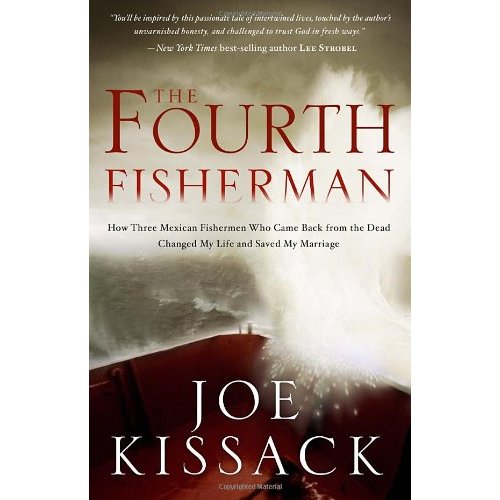
The Fourth Fisherman by Joe Kissack

The Fourth Fisherman by Joe Kissack is the true story of three Mexican fishermen lost at sea for more than nine months. The fishermen were believed to be dead, but in a shocking turn of events, a Chinese fishing crew happened upon them near the coast of Australia, where they had drifted more than 5,500 miles across the Pacific Ocean.

Woven within this amazing story of survival is another “survivor” tale. The story of Joe Kissack, successful TV media mogul, tells of a man so wrapped up in his own success and wealth he finds himself lost in his own personal sea of misery. Enveloped in addiction and depression, Joe finally hit rock bottom. It was there that he found salvation and recovery in the person of Jesus Christ.

The Fourth Fisherman is a compelling tale of an incredible, almost unbelievable, story of survival and hope. Not just for the fisherman, but for Joe—the “fourth” fisherman. Eventually Joe and the fishermen meet face to face where their stories finally converge. Joe fights for several years to make sure the fishermen’s story of faith is appropriately represented in the media. He finds, however, that the majority of Hollywood is only interested in the gruesome, and often completely inaccurate, details of the fishermen’s story. A story—the true story—of faith which led these men to persevere is nowhere on the media’s radar.

This in an amazing book, and truthfully once I started it I could not put it down. Not only is the tale of survival amazing, but also how God worked out the intricate details to allow the lives of Joe and the fishermen to cross, enabling the story of their faith and perseverance to be told. This book reads a lot like a novel and there is not one dull moment to be found in its pages. Joe is honest about his struggles too, which I especially appreciated. I can’t think of a single person who would not be blessed and encouraged through the reading of this story.

The Fourth Fisherman by Joe Kissack was published by Waterbrook Press in March 2012 and is currently available for purchase.

(I received this book from Waterbrook Multnomah in exchange for my honest review. I was not required to give a positive review and the opinions expressed here are strictly my own.)

When Life’s a Herd of Chaos by Rachel Quinley

When Life’s a Herd of Chaos by Rachel Quinley has to be one of the most unique devotionals I have ever read. I absolutely love it. I think I’ve read so many devotionals over the years I’ve become jaded. After all, how many times have lovely sentiments been written with a verse tacked on and a prayer thrown in? Don’t get me wrong, I love devotionals, obviously, because I write them as well. But sometimes they all run together in an ooze of inspiration that never really does what it’s intended to do: awaken spiritual growth.

Such is not the case in When Life’s a Herd of Chaos. This devotional is not only different than anything you’ll probably read (as far as devotionals go); it is also riddled with humor. Rachel has so much charisma as she retells her personal experiences and challenges the reader to examine their hearts. I really cannot praise this book enough. As typical for a devotional, each inspiration has a verse and prayer included, but even the format behind that is much different than one might expect. The illustrations are marvelous and unexpected. I found myself laughing and being convicted in the time span it took to read the short writings—about two minutes or so. The following are some examples of chapter titles to whet your appetite:

Who Gives a Care?

Feel Like a Reject?

In a Jam and Can’t Get Out

A Quarter-Back Christian

Don’t Explode—Go Slow! When you’re ready to wrap a golf club around a tree because you missed a shot, step back, lay the club down, and if necessary, pick up your bag and go home. That’s better than ruining your golf club—and Christian reputation.” (pp.21-22)

The above quote is one of many humorous illustrations making important—convicting—points of truth. I love this devotional, I refer to it over and over again, and I strongly urge you to pick up a copy for yourself. Rachel Quinley sent a copy to me personally, and she assures me she will do the same for anyone else interested. You can contact her at rachelquinley@att.net for pricing and shipping information. You can also read more from “When Life’s a Herd” as well as other inspiring devotionals on her blog: Rachel’s Knee Mail.

(I received this book from Rachel Quinley in exchange for my honest review. I was not paid to give a good review, and every opinion here is strictly my own.)

Rachel Quinley is an experienced writer and speaker, having traveled throughout the United Staes, Canada, and the Caribbean Islands, sharing devotions at Christian seminars and conferences. She is also a published writer for magazines and leadership manuals. Rachel and her husband, Ernest, live in Mobile, Al.

Red Letter Revolution by Shane Claiborne and Tony Campolo

Red Letter Revolution by Shane Claiborne and Tony Campolo could be aptly described as the Red Letter Revolution Movement’s manifesto of sorts. The text is written out as a dialogue between Tony and Shane, explaining their views/beliefs regarding a wide assortment of topics from racism, abortion, church history, liturgy, and much more. All of these tied in to what they call the “Red Letter Movement”–a group of self-described radicals who believe the keys to living are found solely within the red letters of Christ found in the Gospels.

I was initially interested in the book based solely on the title. What Christian doesn’t want to live out the “red letters” of Jesus? An unbelieving world would likely view a sold-out Christian as being radical, so that term alone didn’t resonate negatively with me. Unfortunately, I didn’t get far into the text before disappointment set in. While I didn’t mind the dialogue-type format, I did mind the modern slant and somewhat “new-age” overtones sprinkled throughout the text. I was also quite disappointed in the lack of Scriptural evidence used to back up any of the author’s opinions. Perhaps I was to simply trust their words as truth.

Not wanting to make a rash judgment, though, I stuck with the book as long as possible, but in the end I could not finish it. Certainly my opinion is not a reflection of the authors’ character, as I believe their faith to be wholly genuine and heartfelt. I have no doubt they mean what they say, and live what they believe in an active way.

Most Christians would agree that no one is a judge of the heart except God. It is very possible that there are genuine believers amongst all faiths. What I don’t ascribe to, however, is the need to adopt the practices of various faiths which differ from my own. In the chapter “Dialogue on Liturgy”, Shane talks extensively about reciting certain prayers along with the benefits of using prayer beads. His suggestions, though well-intentioned, set off alarm bells for me. His argument is mostly based on the “works” of many catholic saints and nuns—their works being an outward display of a genuine love for Christ. I have nothing against Catholics, Mormons, Methodists, or anyone else. But I cannot agree with being good (as in doing good deeds) as a sole evidence of genuine faith. A lot of people do great things in the world, but they do not really know Christ. I believe that type of thinking is dangerously erroneous. Tony goes on to say,

“Spiritual disciplines, which include liturgical practices, are requirements for those who are committed to living out the red letters of the Bible. Such disciplines keep us focused on Christ and facilitate our surrendering to an infilling of Christ’s spirit.” (pg.40)

The last thing I need is more practices and procedures to prove to the world I am who I say I am (Christian). Should I cross myself before I pray as well? Will that give me more of the Holy Spirit? I’m sorry, but I do not need beads, books, or regulatory prayers to ensure I am communicating appropriately with Jesus. This is not a judgment against those who do use these things—it’s just not for me. Furthermore, I have no knowledge of such disciplines being a requirement for the filling of the Holy Spirit, and don’t appreciate the implication that I cannot be a “red letter” Christian or filled with the Spirit unless I adopt such practices.

Overall the tone of this book comes across (to me) as very worldly, new aged, and mystical. I would not recommend this book to anyone, unfortunately. My suggestion for someone wanting to live out the life and words of Jesus is to study the Bible—all of it. Not just the red letters, but the black letters of the Old and New Testaments. Surrendering to Christ is the real beginning to reflecting His character. If one wants to study beyond the Bible, I would encourage that person to seek doctrinally sound material and to weigh any books/study guides against the authority and accuracy of Scripture.

Red Letter Revolution is published by Thomas Nelson and available for purchase on Tuesday, October 9, 2012.

**I received Red Letter Revolution from BookSneeze in exchange for my honest review. I was not required to give a positive opinion–and all of the sentiments written here are strictly my own.**

You Think YOU Have Waited a Long Time?

“[Elijah] went a day’s journey into the wilderness…and he requested that he might die; and said, ‘It is enough now, O Lord, take away my life.’” 1 Kings 19:4 (KJV)

Elijah was one of the greatest prophets who ever lived, yet even he had unanswered prayers. After being assured by Jezebel that his life would come to an end, Elijah ran for the hills. He was so weary, so discouraged, he was ready to throw in the towel, give up the fight, and be at rest in the arms of God.

God did not see fit to answer this prayer, nor has He ever answered it. The book of Second Kings records how Elijah was taken by a flaming chariot into heaven without experiencing the physical death he had wished for.  So—end of story, right?

Wrong.

Skip ahead a few centuries and we find in Revelation 11 that God has remembered Elijah’s prayer and answered it.

“And when [the two witnesses] have finished their testimony, the beast that ascendeth out of the bottomless pit shall make war with them, and shall overcome them, and kill them. And their dead bodies shall lie in the street of the great city…” Revelation 11:7-8

And who are these two witnesses? According to Malachi, one of the witnesses is Elijah.

“Behold, I will send you Elijah the prophet before the coming of the great and dreadful day of the Lord: And he shall turn the heart of the fathers to the children, and the heart of the children to their fathers, lest I come and smite the earth with a curse.” Malachi 4:5-6

Elijah’s prayer was heard and will be answered—he only needed to wait a few thousand years. I don’t know about you, but I get antsy after waiting a day or two for an answer to my requests. In fact, just two weeks ago God answered a prayer I had been bringing before him for over a year. It happened in a most unexpected way (which seems to be the case most often), and even today I marvel at the circumstances surrounding His answer. But there is a big difference between one year and a thousand. I can’t say for sure, but I probably would have given up believing a positive outcome was possible if a few more years had passed.  And yet, I have other requests that have been waiting for an answer for many years. Will I choose to trust God?

Understanding Elijah’s plight gives me great hope. God does not forget my prayers, even if it seems like He has decided not to answer them. The fact is, I only see the steps in front of me but I don’t see (or understand, usually) the big picture. Maybe my unanswered prayer has a greater purpose for another time—perhaps even decades or centuries from now.

Today I will continue to lay my requests at His feet, knowing He hears, He cares, and He will answer one way or another in His perfect time.

“I have called upon thee, for thou wilt hear me, O God: incline thine ear unto me, and hear my speech.” Psalm 17:6

Six Signs of a Spiritually Divided Heart

**Originally Published on Encourage 365, October 1st, 2012**

A cursory glance through Psalm 119 reveals the heart of an author wholly enveloped in the words of God. It is blatantly obvious the Psalmist not only read the word of God on a regular basis, but lived its truth in his every-day life. Psalm 119 provides all the answers we could ever hope for in regards to approaching the Bible with an undivided heart.

So how do I know if I’m seeking God with all my heart? How do I know if I love God with all my heart? How do I know if I believe God with all my heart? How do I determine if my heart is divided or united to fear God’s name in truth (Psalm 86:11)?

1. A spiritually divided heart is emotionally unstable.

“Blessed are they who keep his statutes and seek him with all their heart.” (Psalm 119:2) The Hebrew word for “blessed” in this passage is ‘esher (eh’-sher) which translates “happy”. Blessed does not mean wealthy, successful, powerful, popular, or prominent though it may certainly be a blessing to have those statuses. A divided heart is revealed in a saddened or discouraged countenance. Is my life characterized by happiness and peace or worry and confusion? Am I tossed into the depths of despair through every undesirable circumstance or have I entrusted my innermost source of happiness to God’s word? The only way I can have lasting happiness is to walk by and believe God’s word of truth.

2. A spiritually divided heart is wandering.

“I seek you with all my heart; do not let me stray from your commands.” (Psalm 119:10) God’s word is not a list of rules keeping me boxed in under the heavy thumb of dictatorship. God’s word was inspired and written for my greatest good. The Bible clearly outlines and defines what path to travel, what attitude is appropriate, and what ministries to pursue. When I start to rely on my own reasoning, logic, and understanding, I stray from God’s perfect knowledge of His creation—me.  My heart is divided when I fight against the truth of God’s revealed word and willfully or ignorantly choose my own path.

3. A spiritually divided heart is selfish.

“Turn my heart towards your statutes and not toward selfish gain. Turn my eyes away from worthless things; preserve my life according to your word.” (Psalm 119:36-37) Left to my own devices I am bent towards selfishness. When I argue with my spouse over where to eat dinner I put my needs in front of his. When I am offended by the opinions of others, threatened by the status of a peer, or hesitant to give of my abundance to someone in need, I am selfish. I have strayed from God’s word and will and allowed my flesh to take over. My heart has been divided. I have failed to esteem others as better than myself (Philippians 2:3).

4.  A spiritually divided heart is inconsistent.

“This has been my practice: I obey your precepts.” (Psalm 119:56) Can I truthfully proclaim that I obey God’s word without falter every second of every day? Not a chance. However, the undivided heart, or the heart walking through life believing God’s word, will be swayed towards obedience. Willful rebellion will be the exception, not the rule. When my daily practice is devoted to knowing and following God’s word, my heart is united in truth.

5. A spiritually divided heart is malnourished.

“How sweet are your words to my taste; sweeter than honey to my mouth!” (Psalm 119:103) When I am hurt, angry, confused, or otherwise afflicted, where do I turn for guidance and comfort? Do I seek the opinions of friends, family, pastors, and teachers first or do I seek the counsel of God? The more of his words I consume, the more nourished I will be. When I neglect his guidance and first seek help from human sources I am left hungry and malnourished. If I don’t know the word of God, how will I know if the advice I’m given is biblical? Like the prophet Isaiah so eloquently stated: “Why spend money on what is not bread, and your labor on what does not satisfy? Listen, listen to me, and eat what is good and your soul will delight in the richest of fare.” (Isaiah 55:2)

6. A spiritually divided heart is fearful.

“I will speak of your statutes before kings and will not be put to shame, for I delight in your commands because I love them.” (Psalm 119:46-47) If my Monday through Saturday life does not line up with my Sunday life, I should be afraid to speak of my faith. Without a living, active gospel displayed through my life, I will be put to shame when I witness to others. How can I preach to someone when my life is the opposite of my message? When I hear of terminally-ill loved ones, if unsure about their eternal destiny, I am motivated to witness to them before it’s too late. But was I motivated to witness before I knew they were sick? Shouldn’t every day be an opportunity to love God, live God, and display God in everything I do?  If I am not displaying the love of God by witnessing to my lost friends and neighbors, I am living in fear. I want my life to always back up my message and never distract from the wonderful, freeing truth of the Gospel of Christ.

Every time I read Psalm 119 I am reminded to check my heart-status. Am I whole-heartedly seeking God and his word or am I offering up only the pieces I prefer? Can I stand beside the Psalmist and before God, unashamed and fully exposed and still declare, “My soul is consumed with longing for your laws at all times. Your statutes are my delight and I have chosen the way of truth.” (Psalm 119:20, 24, 30) That is my desire; to live with an undivided heart wholly united with God’s word.

What Does it Mean to be a “Healthy” Christian?

**Published in The Christian Online Magazine, October 2012**

What Does it Mean to be a “Healthy” Christian?

You can’t go very far without hearing the word “healthy”. It’s on every newsstand, magazine cover, and diet book. Ironically, these publications will claim to know the secret to becoming healthy, yet none of their articles will point to the same solution. How is a person supposed to know what direction to take?

As Christians we are admonished not to follow the patterns of the world (Rom. 12:1-2), but that doesn’t mean we shouldn’t concern ourselves with our physical health. Yet even more important than our physical health is our spiritual health. The more “in tune” we are to God’s Word, the more motivated we are to make wise decisions concerning our physical bodies. Physical and Spiritual cannot be separated. We are to honor God with our whole bodies, not just the pieces we want to give Him.

So, that leads us to the question—as a Christian, what does it mean to be “healthy”? I recently posted this question on Twitter and received some responses.

@Gregparker16 tweeted: “Being on your knees in front of the Lord every night.”

@Hasten_Home tweeted: “Functioning in full contact & strength in the capacity God intended.”

Both of these answers are excellent. But let’s take it a step further and find out what the most important Book has to say. After all, is there any better advice then what is found in the Word of God?

3 John 1:2 “Beloved, I wish above all things that thou mayest prosper and be in health, even as thy soul propsereth.” (KJV)

The best way to understand any verse is to go to the source of writing, that is, the original language. So much gets lost in translation. The Greek and Hebrew languages are very complex and many times a single word is given numerous meanings. So at all times one must consider the context of the passage when interpreting Scripture responsibly.

What we read in 3 John 1:2 is a typical greeting among brethren in the Church. Obviously they wished each other well, just as you or I would ask someone, “How are you?” Greetings such as these were acts of courtesy as well as genuine concern. What I found particularly interesting in this passage was the meaning of “health”. The Greek word “hugiēs” (pronounced hoog-ee-ace) translates: “uncorrupt” or “true in doctrine”. It also means “safe and sound” or “whole”.

And here lies the answer to our question. As a Christian, to be “healthy” is to be whole in spirit (including doctrine). Wholeness begins in our hearts.

We see this same concept displayed throughout Isaiah and Jeremiah. Several times the word “health” is used, and each time it refers to a spiritual wholeness for the sinful nation of Israel (see Jer. 30:17; 33:5-6, Isa. 58:8).

The most important health concern we have involves our spiritual health. A spiritually healthy, balanced Christian will make wise choices in the world, including that of food, activity, and finances.

God is in the business of restoration (wholeness). He often allows brokenness to bring healing—all to the glory of His Name. Psalm 51:8 “Make me to hear joy and gladness that the bones which thou hast broken may rejoice.” The Hebrew word for “bones” in this passage is not referring to the literal bone matter holding David together, but rather the spiritual matter. Translated from Hebrew the word “bones” means “substance of life”—in other words, his spirit. God allowed David to experience spiritual brokenness so He could bring David through the valley of repentance towards the mountaintop of restoration.

Do you want to be a healthy Christian? It begins with God’s word–obedience to it and cleansing by it. We don’t drive a car without first using our minds to get in the car, turn on the engine, and press the gas pedal. Likewise, we can’t expect to make wise life-choices in any area if our minds are not aligned with the absolute truth of God’s Word.

“I have chosen the way of truth…I will run to the path of your commands, for you have set my heart free.” Psalm 119:30, 32 (NIV)

© Rebecca Aarup

A Jesus Diet?

I didn’t grow up in a “fasting” household. I knew about fasting, but had never seen anyone practice it, much less preach about it. As an adult I’ve only been led to fast a handful of times, once for 3 days, and all the other times for only a day. A few days ago a friend of mine posted a link on her Facebook page to this site: www.40daystosaveamerica.com and I clicked on it. Immediately God impressed upon me the desire to do a 40 day fast while not only praying for our nation before the elections, but seeking a personal spirit of revival and repentance.

No matter what comes of the elections, or what side of the street we stand on concerning politics, I think we can all agree that the world needs revival—Christians need revival. This is something we can all be praying for in our own hearts and the hearts of our brothers and sisters.

Not everyone will be called to do a 40 day fast, and many will feel led to give up something other than food. I know some who are doing a Facebook fast, a coffee fast, or giving up other things and exchanging those wants for prayer. Fasting or not, earnest, sincere prayer is essential for the Christian.

And just in case I was feeling like maybe I heard God’s voice wrong (or even hoping I heard wrong!), I received the following devotional in my email this morning, which happens to be day #1 of my fast. It spoke directly to me, and I know you’ll be blessed by it as well. No matter what you choose to do for the next 40 days, I hope you will dive deeper into prayer for whatever God lays on your heart. This time will certainly not be wasted, as we know He saves every prayer for a future sacrifice of worship (see Every Prayer Uttered).

Blessings, my friends!

~Rebecca


A Diet in Jesus’ Name?
By Skip Heitzig

We focus a lot on food. Eating is one of our favorite pastimes, and we talk a lot about food. There are even place names that are foods. There’s Two Egg, Florida… Bacon, Delaware… Pancake, Texas… Hot Coffee, Mississippi.

One thing you don’t hear a lot about today is fasting. But did you know the Bible mentions fasting more times (nearly 60!) than even the “important” subjects like baptism?

Fasting is not a “diet in Jesus’ name.” It’s not a way to lose weight and be blessed. Fasting is done for spiritual motives.

In the Bible, fasting was done in times of danger, like when Esther was preparing to approach the king of Persia (see Esther 4). It’s a part of repentance: Both Daniel and Ezra fasted in response to the sins of the people, and the king of Nineveh ordered a fast when that city repented (see Jonah 3). Fasting was done in preparation for an important task or ministry. Jesus fasted 40 days and nights before He began His preaching ministry, and the apostles fasted before they sent Paul and Barnabas out (see Acts 13).

Fasting is a time when we take the focus off of ourselves, and put it on God and His will. (And that’s hard, in a culture where we worship self-reliance, self-determination, and self-worth!) Fasting reminds us that we belong to Him and that He owns us (see 1 Corinthians 6:19-20.). It’s a time when we discipline the body, and make our appetite our slave rather than our master.

In Matthew 6:16-18, Jesus speaks of hypocritical motives for fasting. Note that he says “when you fast,” not “if.” Fasting is not to be for some group in a monastery; it’s to be the norm!

Jesus’ point was that God never fails to notice fasting that is heartfelt and genuine, and that He will reward it. (Note: We don’t fast to gain God’s favor or “twist His arm” so He will do something!) But how would God reward a fasting saint? Through deeper intimacy with Him. By letting us know His will. By giving us clarity of understanding in a difficult situation, or a new strategy for ministry.

There are benefits to fasting (and here I’m going from less to more spiritual):

Fasting is good for our health. During a prolonged fast, the body lives on surplus fat. It renews the body and the mind. It helps the body control weight and dispose of wastes.

It teaches us self-discipline. Many of us are slaves to habits, but fasting makes desire our slave rather than being our master. It reminds us we can live without a lot of things. The prayer, “Give us this day our daily bread” will be more meaningful.

It helps us appreciate God’s gifts more. Fasting helps us feel our dependence upon God in this affluent, self-sufficient society.

It helps us see the needs of others: Going without food gets us in touch with people who live that way every day. That will make our prayer life more effective as well as activate us to help.

Fasting is always accompanied with prayer, and it will boost your prayer life. It’ll sharpen our praying—it changes the way we pray…and perhaps the results.

The pleasures of eating are fleeting, but the pleasures of fasting are lasting!

Copyright © 2012 by Connection Communications. All rights reserved.


Every Prayer Uttered


“Each one had a harp and they were holding golden bowls full of incense, which are the prayers of the saints.” Revelation 5:8

(Suggested reading: Revelation 5:1-14)

Psalm 56:8 tells us that God holds every tear we’ve shed in a Divine bottle. He hears every sob; He takes into account every painful moment we’ve experienced. We’re also told in Revelation that God has another Divine container—a bowl. This bowl preserves every prayer uttered by every saint from Adam to the end of time.

When we praise Him in worship, when we thank Him for our meal, when we cry out in anguish over our sin—every single utterance is preserved for a culminating moment in history.

Just imagine, all the host of heaven is gathered around the throne of the Father. Jesus, at the right hand of the Father, holds the Scroll sealed with seven seals. He alone stands worthy to reveal its contents. This knowledge causes all of heaven to bow in worship,

“You are worthy to take the scroll

and to open its seals,

because you were slain,

and with your blood you purchased men for God

from every tribe and language and people and nation.

You have made them to be a kingdom

and priests serve our God,

and they will reign on the earth.”

Revelation 5:9

As this proclamation thunders throughout heaven, the four living creatures and twenty-four elders fall before the Lamb, pouring out a sweet smelling sacrifice of incense. This sweet smell, this glorious offering is poured out at the feet of Jesus. Your prayers, my prayers, our ancestor’s prayers, the prayers of every martyr, and the prayers of every biblical “hero” now becomes a sacrifice of worship. Not one of them is wasted. No, not one.

Every prayer uttered is an offering–an offering now and an offering to come.

Worthy is the Lamb both now and forever, Amen.

RebeccaAarup's avatarRebecca Aarup

Suggested Reading: Ecclesiastes 12:13-14

“Follow the ways of your heart and whatever your eyes see, but know that for all these things God will bring you into judgment.” Ecclesiastes 11:9b

The decisions of today affect the experience of God’s kingdom tomorrow. We weren’t created for this moment, we were created for eternity. Likewise, our choices have an eternal weight. Life is fleeting, our youth wanes, but His word endures for all time.

We are free to choose fun, free to choose hobbies, free to choose jobs, and free to do as we please but God, enthroned above all, is free to judge His creation.

“Fear God and keep his commands” is undoubtedly the wisest advice ever penned in Scripture. Obedience in this point will result in obedience in all points. One choice stands between mercy and wrath; judgment and reward; ruling on high or regret down low.

Freedom for pleasure…

View original post 8 more words