
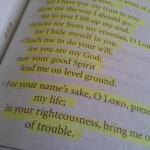
So, what is YOUR word?

psalm143“What will you do?”

As I’ve heard sermons, read books, and sat through lectures throughout the year, I’ve heard the voice of the Spirit resounding loud and clear, “So, what will you do about it?” God has strategically batted that ball back to my side of the net over and over—spurning me to embrace an active faith, and it makes me uncomfortable. But then I remember a prayer I uttered, albeit not well-thought through at the time, for God to make me uncomfortable. Really, that prayer should be right at the top of the list of “things you don’t ask God”, right behind praying for patience or a spirit of forgiveness. Well, I’ve learned my lesson—God answers prayers for sure, especially the character building ones.

At the start of 2012 a friend of mine posted a blog about a challenge (read it here: MY One Word), a challenge to ask God about what “word” to focus on for the following year. That sounded neat, so I gave it a go. I cheerfully got on my knees and asked God what my special word for the coming 2012 year would be, I anxiously listened, hoping to hear prosperity, success, purpose, or anything along those lines. Instead, after a few moments of silence, I heard “perseverance”.

“Um, Lord, really? I mean…really?” Some of my friends were getting words like “go” and “action” and I got perseverance? I didn’t like it; I wanted to take back the prayer. What was God thinking, anyways? I had always been somewhat known for starting things and losing interest over time, eventually abandoning the project or idea. But looking back on 2012, I can see how God used the trials of one of the most difficult years I have faced to break my pride, provide me with ultimate spiritual freedom, as well as teaching me self-discipline and yes, perseverance.

I would be lying if I said I wasn’t happy to start a new year, because even though it’s just another day on the calendar, somehow turning the page and writing a new number (2013) just feels like a fresh start. I’m looking towards 2013 with great expectation—expectation in God’s revealed will (HIS Word) and not my own clever ideas. I still haven’t prayed about the new word for next year, but I’m not as scared about it as I was last year. Looking back I know that no matter what, God knows what He is doing and I can really, in fact, trust Him in all things, even the hard, painful, and uncomfortable things. That no matter what the situation, His character is constant, even if I’m not feeling like it is.

His character is constant, yes, perhaps the biggest lesson I learned this year. My character? Not so much. Which is why the prayer, “Lord, change me” has been cried out more times than I can accurately recall.

So, mingled in with words like illness, death, betrayal, loneliness, slander, hatred, consequences, loss, depression, despair, relapse, and uncertainty have been the words of truth—healing, restoration, freedom, hope, peace, purpose, fulfillment, grace, mercy, understanding, and love. All of the awfulness has actually taught me how to be an optimist of sorts. An optimist in God, not in myself. An optimist in His character, not in my ability.

I’ve asked, He has answered, and none of His responses were as expected. Through all of this I am learning that maybe, just maybe, He really does know better than I do.

“Teach me to do your will, for you are my God; may your good Spirit lead me on level ground.” Palm 143:10

What theme has God brought to your year? What “lesson” have you learned through trials or blessings? Post your comment here or join the discussion on facebook.

__________________________________________________________

profilepic3Rebecca Aarup is an author and freelance writer. She is also a health columnist for The Christian Online Magazine, a contributing writer for Encourage 365, creater of S.E.R.V.A.N.T. Sisters women’s ministry (online), and has written devotionals/studies/articles for a variety of publications. She just released a new Bible Study The Word: Six Lessons from Psalm 119 which is available as a free download on her website or in print form from Amazon. Beyond writing, Rebecca is a wife, home-schooling mom, and Bible student at Liberty University. She lives in Glendale, Arizona with her husband Chris and 5 year old, Samantha.  You can read more from Rebecca by subscribing to her blog (it’s free) and following her on twitter and facebook.


Even the Pomegranates Cry Out

Chop. Chop. Chop.

I seem to have the best God-moments when I’m feverishly hacking away on a helpless piece of food, trying to work out my anger. It has come to be a habit. We fight—I cook. It’s how I wrestle with my emotions, think, pray, and take several deep breaths while annihilating a target other than my spouse.

“Ok, God, I know what you said in 1 Corinthians 10:13, I’ll never forget that verse…but, I’m starting to think You enjoy taking me to the edge of what I can handle.”

Chop. Chop. Chop.

Silence.

“Ok, You’re not talking. That’s ok, I have plenty to say…”

If God could get frustrated, I am sure I’d be His number one cause of irritation. “Oh, here’s Rebecca again, whining like it’s the end of the world. If only she knew how bad it could really be, maybe then she’d be grateful.”

Of course, I know God isn’t really thinking that towards me, in fact, what He is thinking about me is too mind blowing to comprehend. For example, “You did not choose me, but I chose you and appointed you to go and bear fruit—the fruit that will last.” (John 15:16)

Oh, and speaking of fruit? Yeah, I was carving up several pieces of fruit to make a fresh fruit salad while conversing with God in a less-than-humble way.  He never spoke to me in those heated moments, not audibly at least. But He did find a way to cut through my incessant ramblings of self-pity.

I don’t know about you, but I enjoy seeing God in nature—all facets of nature from animals to the weather to food. My social media friends are well aware of this due to the multitude of pictures I post of the food I’m cooking, the clouds in the sky, or my dog acting exceptionally cute. Creation is beautiful, and in it I am made aware of God’s presence in the details.

Slice. Slice.

285-Pomegranate


And then it opened and my breath was taken away. As the crimson juices ran over my fingers and the seeds spilled out my thoughts were interrupted. “Oh, Lord, it’s so beautiful! It’s like a honeycomb giving birth to rubies!” And for a second I was so captivated by the gorgeous intricacies of that pomegranate that my self-centered complaints were replaced with worship and gratitude.

How could I ever doubt a God who took so much time carefully designing every piece of fruit to not only taste good, but look good as well? But doubt I do—and often. It’s so easy to forget in the heat of the moment. To forget all things good and grateful and focus on the ugly and distasteful.

Fortunately, God is not surprised by any of this. He knows what I will say, how I will react, and whether or not I’ll confess it. He knows I will continue to grieve His spirit unintentionally when I allow bitterness to take root, and He knows the exact moment I will fall on my knees and give it all to Him and choose peace.

When my voice fails to speak of His love, surely the pomegranates cry out in my place.

“My soul will be satisfied as with the richest of foods; with singing lips my mouth will praise you.” Psalm 63:5  

_________________________________________________________

profilepic3Rebecca Aarup is a health columnist for The Christian Online Magazine, a contributing writer for Encourage 365, founder and creater of S.E.R.V.A.N.T. Sisters, and has written devotionals/studies/articles for a variety of other publications. She just released her latest Bible Study The Word: Six Lessons from Psalm 119 which is available as a free download on her website or in print form from Amazon. Beyond writing, Rebecca is a wife, home-schooling mom, and Bible student at Liberty University. She lives in Glendale, Az with her husband Chris and 5 year old, Samantha.  You can read more from Rebecca by subscribing to her blog (it’s free) and following her on twitter and facebook.
Yes, He Does

**Originally Published on Encourage 365, December 2012**


Yes, He Does

“[Jesus] became flesh and blood and moved into the neighborhood.” John 1:14 (MSG)

It was God who made the first move, not me, not you, not mankind. Just like He did in the Garden of Eden as God Himself walked through the thick brush of foliage to find His children. “Where are you, my son, Adam? Where are you my daughter, Eve?” God made the first move to seek out His beloved while at the same time His beloved were running the other way.

Jesus became flesh, He became human not only to save the world from sin, but to show us that He does care, He does understand, He does empathize.

Imagine being the King of all kings and coming down to this sinful planet, all the riches of the world at your disposal and yet you are essentially homeless. You choose a life of servant humility so no one can say you don’t understand. Of course He understands. He felt loneliness, injustice, persecution, rejection, loss, and grief. He knows, He hears, He cares, and He understands. Yes, He does. He lived it, walked it, breathed it, and yet persevered without doubt. He knew His heavenly Father was always moving toward Him and us. He demonstrated that truth through His life, by coming to us as flesh and blood, walking among us, serving us, and loving us, and finally, dying for us.

“We don’t have a priest who is out of touch with our reality. He’s been through weakness and testing, experienced it all—all but the sin. So let’s walk right up to Him and get what he is so ready to give. Take the mercy, accept the help.” Hebrews 4:15-16 (MSG)

Hunched over the toilet, tears streaming down my face, uncontrollable wretching—probably the worst physical reaction I have ever had to stress. I found myself on my knees in the bathroom asking God if he really understood. “Really, God? Really? You’re up there, you can do whatever you want, and yet you allow this…this nonsense. Do you even know what I’m going through?”

In one day I had lost a beloved pet of nearly twelve years, quite unexpectedly. My five-year old wept, unable to comprehend why her beloved kitty was not coming home–how she was fine one day and just—gone—the next. And just moments before finding out about my cat, we received notice of a lawsuit against us; a dispute with a previous landlord that had been ongoing for over a year. They had summoned us to court by sending the order to a previous address (an action that is legal in my state), despite having our new address, so we were unaware of the order to appear in court. They sued us for damages well documented on our move-in sheet (in other words, the damages were there before we moved in). This lawsuit, barring a miracle, will ruin us financially (not that we were doing that well to begin with!)  Just when our family was beginning to recover from a financially difficult year, a bombshell blows. Unable to find work, the burden rests on my unbelieving husband. He asks me why my God would allow such unfairness to continue in our lives and I had no good answers.

But then…

As the pastor preached on John 1, he prayed that our eyes would be newly opened to truth despite the familiarity of the passage. Surely God moved toward me in that moment and revealed Himself again. He didn’t change my circumstances, but He did allow me to accept them rather than fight them.

Something awaits me in this mess. I don’t know what, exactly, but I know God is not sitting “up there” with His arms crossed, laughing His head off at our plight. Probably a thousand different reasons could be drawn up as to why this is all happening once again around Christmas (which seems to be a theme in my family—December disasters is how my husband refers to it.) But one thing was certain to me as I listened to my pastor, God is here, He is moving toward me. Toward me? I am overwhelmed with mercy and grace. All of a sudden I don’t need to know the why, how, or what. God ordains my steps, and now I ask Him, “Where do I go now? What is my next move? Give me wisdom to know and faith to believe you’re in control.”

He doesn’t want us to toss aside our pain as if it doesn’t compare to what He did for us, He is not trying to give us some divine guilt trip. Instead, He offers His presence among us to comfort and heal us. We learn faith as we experience these things. It hurts and that is ok. He knows and He pursues us in our grief. I can almost hear Him saying the same thing to me as He did to Adam and Eve, “Child, where are you? I am here, I want to help you. Come to Me; rest in Me; find peace in Me. I understand, yes, I do.”


Black Friday Book GIVEAWAY!

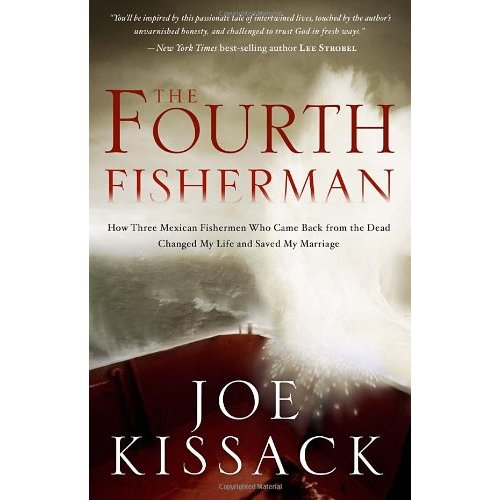
Ok, everyone and their brother is doing a book giveway so I figured I would jump on the bandwagon. I’ll be giving away a hardcover copy of The Fourth Fisherman by Joe Kissack (value $23.99) along with a print copy of my short Bible study The Word: Six Lessons from Psalm 119 (value $3.99). Entering is super easy, simply click on the “share” tab to share this post with your friends on facebook, twitter, google, or whatever! Then comment in the comments section “I shared!” I will select a winner on  Monday, November 26th.  NOTE: Your name will be entered for each time you shared this post. Whether that is through facebook, reblogging, or twitter, or whatever social media outlet you use. Make sure you comment “I shared” EACH time you share this post so I know how many times to enter your name in the drawing.

The Fourth Fisherman would make an excellent Christmas present as well, and The Word:Six Lessons from Psalm 119 would make an excellent stocking stuffer! So, you could win these books and keep them or “re-gift” them. Either way, I look forward to sending them off to the winner.


“First-World” Problems

**Published on Encourage 365, November 2012**

On Sunday my Pastor showed a riveting video called “First World Problems Rap” and the irony of this video should be evident to any viewer.  I appreciate the message and encourage you to watch it (it’s only two minutes).


(Here’s where you click the link to watch the video before reading on…)


So, yesterday our church launched a 30-day challenge to start a “First World Problems” complaint jar. You guessed it, every time we catch ourselves complaining about a “problem”–much like what is depicted in the video–we have to drop some money into the jar. At the end of the 30 days we turn in our jars to the church benevolence fund so the money can be used to help others. Immediately I knew I needed to participate (and I hope you’re challenged to do the same—donating the money to your church or charity).


Making a “complaint” jar is a great idea and something I hope to continue beyond the 30 days. Even in one day both I and my daughter have begun to realize how much we gripe about trivial things. Let’s face it, waiting in line at Starbucks really pales in comparison to the trials most children face in third world countries. I am ashamed to even admit how often I forget to pray for those children. Most of us will never get the opportunity to travel to a destitute country and personally help, but most of us do have the capability of helping out through active service in our communities.


The church I attend has several outreach groups that work with homeless people, foster children, disabled children, hungry families, and more. Even if your church does not offer these things, there is something somewhere that you could probably get involved in. Even if it’s just dropping off canned foods for a food drive or hygiene supplies to homeless communities. The needs are there, we just need to open our eyes and look (and pray) for opportunities.


All of our situations are unique. My situation requires me to be home much of the time. I’m a wife, I home-school my daughter, I’m a full time student, and a freelance writer. I am in my home a lot! But a few months ago I prayed for God to show me what I could do to get “hands-on” and He was faithful to immediately answer that prayer! Sometimes we are fooled in to thinking we don’t have the time or resources to make a difference when the reality couldn’t be further from the truth. We may never know what impact our small acts of kindness could have on another life.


So my challenge to you is the same challenge my Pastor shared with the congregation. Make a complaint jar and keep track of just how often you complain about “first world” problems. The results will probably be shocking. Remember, the point is to change our perspective. Faith is supposed to be active. Jesus didn’t just sit in the synagogue all day and preach. He was out there demonstrating a hands-on faith, as were the disciples. And we’re all familiar with James 1:27, “Religion that God our Father accepts as pure and faultless is this; to look after the orphans and the widows in their distress and to keep oneself faultless from the world.”This is the kind of faith I want to demonstrate to the world; this is the kind of faith I ask God to create in my life.


A faith that moves.


“And let us consider how we may spur one another on toward love and good deeds.” Hebrews 10:24

(Also see related article: Let’s Do Justice from Prodigal Magazine)

Spiritual Reboot: Four Ways Fasting Benefits your Body and Spirit

**Published with The Christian Online Magazine, November 2012**

Spiritual Reboot: Four Ways Fasting Benefits Your Body and Spirit

A lot of controversy surrounds fasting; a quick Google search reveals doctors who wholeheartedly support it and others who are adamantly against it. As Christians, we need to look to Jesus and what His word says when it comes to these issues. In the book of Matthew (4:1-2) Jesus was led by the Spirit to fast, and later He outlines some simple fasting guidelines (6:16-18). So, fasting was not only practiced by Jesus but also taught by Him.

Fasting Benefits Your Physical Body

  • Reboot your “system” with a cleansing fast.

During the first 12-24 hours of a water-only fast, your body begins to break down glucose stored in your liver and muscles, converting it to glycogen to use as energy. After this energy has been depleted, the body begins to use fatty acids for energy. As the fast progresses past two days, the brain uses glycerol (a product of fat tissue) and amino acids from broken down muscle tissue as energy sources.

“Since the bulk of the toxins in your body are stored in your fat reserves, the longer you fast on water only, the more fat you’ll burn and the more toxins you’ll eliminate from your system.” Dr. Ben Kim

Simply stated, fasting for a few days helps the body get a fresh start as harmful chemicals from processed foods and other materials are removed from the body. Some medical studies have even indicated that a fast may help boost the immune system.

  • Put an end to bad eating habits.

Recently I began a ten-day fast and initially I felt freed from the burden of food. I knew, at least for several days, that cooking and wondering about meals would be eliminated from my daily routine. (Don’t worry– I still cooked for my family!)The first day was great—then the second day hit. I would be lying if I said it was easy, because it wasn’t. But what I did come to realize was just how often I was putting food/drinks in my mouth. As the days progressed I eventually felt very little hunger. After the ten days was over, I realized I needed very little—far less than what I had been consuming—to be satisfied and supplied with energy. Now that I’ve come through the fast and am still very much alive and well, I not only feel better physically, but several bad eating habits were effectively broken. (Anybody else have a problem with late-night snacking?) Of course, the spiritual benefits far out-weighed the physical.

Fasting Benefits Your Spiritual Life

  • Obeying the Word of God provides inner peace and contentment.

Those who follow God’s words are blessed, full of joy and peace, and satisfied (Psalm 1; 119; Proverbs 3:1-8). Obeying God through fasting is no exception—it is yet another way we can place our dependence on Christ and get our eyes focused on Him instead of what we think we need. Spiritual eyes are opened during a time of fasting and prayer and when we choose to eat and drink of the Word we are truly blessed in our spirit.

  • Fasting and prayer encourages spiritual awakening and the breaking of sinful habits.

Joel 1:14, 2:12; Nehemiah 1:4, 9:1-3; Ezra 8:23; Acts 14:23; Esther 4:3; Deuteronomy 9:9; 2 Chronicles 1:3; Daniel 9:3–all of these Scriptures reference fasting by God’s people for repentance, direction, instruction, or intervention. Both the Old and New Testaments are full of examples of fasting believers. I hope you’ll take the time to browse the passages listed and see how many ways God chooses to work through fasting.

With only a few days remaining until a critical presidential election, perhaps now is the time to consider fasting for personal and national revival as well as godly leadership in our nation. Or maybe you are struggling with a sinful habit. In any case, seek God first and follow His voice—He is the only one really qualified to lead you in this area.

As always, consult your doctor to make sure it is physically safe for you to fast (but do be prepared to meet mixed opinions from medical professionals on this topic).

A United Heart

Lou Ann stopped by my blog a few days ago and in turn, I visited her blog. I love her heart, her mission, and her writing! So, I am sharing it with you. Please read her short devotional on what it means to have a “United Heart”–obviously a subject near and dear to me. Enjoy!

Teach me thy way, O LORD;
I will walk in thy truth:
unite my heart to fear thy name.
(Psalm 86:11)
Most of this verse is simple in language and easy to understand. I stumbled a little at the word unite. What does it mean here? I looked up the Hebrew equivalent, and it means “unify; join.” Okay, but what is a unified heart or a joined heart? Commentators have several ideas about this word in the context of this verse. It can mean a “completely dedicated” heart or a heart with “undivided loyalty.” I thought of “single-heartedness,” something like single-minded.
In any case, the psalmist profoundly states his desires. This verse is his prayer:
            Teach me Your way.
            I resolve to walk in Your Truth.
            I want a heart that is wholly dedicated to respecting and following You.
Are the psalmist’s desires our desires?
            Do we really want to be taught what God wants us to do?
            Have we ever resolved (promised ourselves) to walk in the Truth (the Bible)?
            Do we have an “undivided” heart to respect and follow God?
In my counseling experience, I have found many women who want to do right. “Oh yes, I want to.” But, they don’t really want to be taught—not by God and not by anyone else either. They have never made a conscious decision to follow and know Truth. They don’t have time for God’s Word, don’t pray, and then they wonder why they’re having such a hard time grasping Truth. They have divided hearts. Part of them wants to do what everyone else does—follow “fun.” And, part of them really wants to follow God, but they’re not fully dedicated (united hearted) to it. Unfortunately, these ladies will always flounder spiritually.
I’ve also counseled women and girls who would say a hearty Amen to the psalmist’s three desires in this short verse. They are growing and changing. And they’re some of the happiest people I know.
May we all have undivided hearts!
Lou Ann Keiser is a missionary pastor’s wife with almost thirty years of ministry experience. She loves Bible study and people. Lou Ann is the mother of two married children and a grandmother. She lives in a quaint little town in Europe.
Please visit her blog: In the Way
**If you or anyone you know enjoys writing, www.servantsisters.org is currently looking for new writers to contribute devotions or photos with inspirational thoughts. You can check out the writer’s guidelines: Write For Us**

You Think YOU Have Waited a Long Time?

“[Elijah] went a day’s journey into the wilderness…and he requested that he might die; and said, ‘It is enough now, O Lord, take away my life.’” 1 Kings 19:4 (KJV)

Elijah was one of the greatest prophets who ever lived, yet even he had unanswered prayers. After being assured by Jezebel that his life would come to an end, Elijah ran for the hills. He was so weary, so discouraged, he was ready to throw in the towel, give up the fight, and be at rest in the arms of God.

God did not see fit to answer this prayer, nor has He ever answered it. The book of Second Kings records how Elijah was taken by a flaming chariot into heaven without experiencing the physical death he had wished for.  So—end of story, right?

Wrong.

Skip ahead a few centuries and we find in Revelation 11 that God has remembered Elijah’s prayer and answered it.

“And when [the two witnesses] have finished their testimony, the beast that ascendeth out of the bottomless pit shall make war with them, and shall overcome them, and kill them. And their dead bodies shall lie in the street of the great city…” Revelation 11:7-8

And who are these two witnesses? According to Malachi, one of the witnesses is Elijah.

“Behold, I will send you Elijah the prophet before the coming of the great and dreadful day of the Lord: And he shall turn the heart of the fathers to the children, and the heart of the children to their fathers, lest I come and smite the earth with a curse.” Malachi 4:5-6

Elijah’s prayer was heard and will be answered—he only needed to wait a few thousand years. I don’t know about you, but I get antsy after waiting a day or two for an answer to my requests. In fact, just two weeks ago God answered a prayer I had been bringing before him for over a year. It happened in a most unexpected way (which seems to be the case most often), and even today I marvel at the circumstances surrounding His answer. But there is a big difference between one year and a thousand. I can’t say for sure, but I probably would have given up believing a positive outcome was possible if a few more years had passed.  And yet, I have other requests that have been waiting for an answer for many years. Will I choose to trust God?

Understanding Elijah’s plight gives me great hope. God does not forget my prayers, even if it seems like He has decided not to answer them. The fact is, I only see the steps in front of me but I don’t see (or understand, usually) the big picture. Maybe my unanswered prayer has a greater purpose for another time—perhaps even decades or centuries from now.

Today I will continue to lay my requests at His feet, knowing He hears, He cares, and He will answer one way or another in His perfect time.

“I have called upon thee, for thou wilt hear me, O God: incline thine ear unto me, and hear my speech.” Psalm 17:6

What Does it Mean to be a “Healthy” Christian?

**Published in The Christian Online Magazine, October 2012**

What Does it Mean to be a “Healthy” Christian?

You can’t go very far without hearing the word “healthy”. It’s on every newsstand, magazine cover, and diet book. Ironically, these publications will claim to know the secret to becoming healthy, yet none of their articles will point to the same solution. How is a person supposed to know what direction to take?

As Christians we are admonished not to follow the patterns of the world (Rom. 12:1-2), but that doesn’t mean we shouldn’t concern ourselves with our physical health. Yet even more important than our physical health is our spiritual health. The more “in tune” we are to God’s Word, the more motivated we are to make wise decisions concerning our physical bodies. Physical and Spiritual cannot be separated. We are to honor God with our whole bodies, not just the pieces we want to give Him.

So, that leads us to the question—as a Christian, what does it mean to be “healthy”? I recently posted this question on Twitter and received some responses.

@Gregparker16 tweeted: “Being on your knees in front of the Lord every night.”

@Hasten_Home tweeted: “Functioning in full contact & strength in the capacity God intended.”

Both of these answers are excellent. But let’s take it a step further and find out what the most important Book has to say. After all, is there any better advice then what is found in the Word of God?

3 John 1:2 “Beloved, I wish above all things that thou mayest prosper and be in health, even as thy soul propsereth.” (KJV)

The best way to understand any verse is to go to the source of writing, that is, the original language. So much gets lost in translation. The Greek and Hebrew languages are very complex and many times a single word is given numerous meanings. So at all times one must consider the context of the passage when interpreting Scripture responsibly.

What we read in 3 John 1:2 is a typical greeting among brethren in the Church. Obviously they wished each other well, just as you or I would ask someone, “How are you?” Greetings such as these were acts of courtesy as well as genuine concern. What I found particularly interesting in this passage was the meaning of “health”. The Greek word “hugiēs” (pronounced hoog-ee-ace) translates: “uncorrupt” or “true in doctrine”. It also means “safe and sound” or “whole”.

And here lies the answer to our question. As a Christian, to be “healthy” is to be whole in spirit (including doctrine). Wholeness begins in our hearts.

We see this same concept displayed throughout Isaiah and Jeremiah. Several times the word “health” is used, and each time it refers to a spiritual wholeness for the sinful nation of Israel (see Jer. 30:17; 33:5-6, Isa. 58:8).

The most important health concern we have involves our spiritual health. A spiritually healthy, balanced Christian will make wise choices in the world, including that of food, activity, and finances.

God is in the business of restoration (wholeness). He often allows brokenness to bring healing—all to the glory of His Name. Psalm 51:8 “Make me to hear joy and gladness that the bones which thou hast broken may rejoice.” The Hebrew word for “bones” in this passage is not referring to the literal bone matter holding David together, but rather the spiritual matter. Translated from Hebrew the word “bones” means “substance of life”—in other words, his spirit. God allowed David to experience spiritual brokenness so He could bring David through the valley of repentance towards the mountaintop of restoration.

Do you want to be a healthy Christian? It begins with God’s word–obedience to it and cleansing by it. We don’t drive a car without first using our minds to get in the car, turn on the engine, and press the gas pedal. Likewise, we can’t expect to make wise life-choices in any area if our minds are not aligned with the absolute truth of God’s Word.

“I have chosen the way of truth…I will run to the path of your commands, for you have set my heart free.” Psalm 119:30, 32 (NIV)

© Rebecca Aarup

A Jesus Diet?

I didn’t grow up in a “fasting” household. I knew about fasting, but had never seen anyone practice it, much less preach about it. As an adult I’ve only been led to fast a handful of times, once for 3 days, and all the other times for only a day. A few days ago a friend of mine posted a link on her Facebook page to this site: www.40daystosaveamerica.com and I clicked on it. Immediately God impressed upon me the desire to do a 40 day fast while not only praying for our nation before the elections, but seeking a personal spirit of revival and repentance.

No matter what comes of the elections, or what side of the street we stand on concerning politics, I think we can all agree that the world needs revival—Christians need revival. This is something we can all be praying for in our own hearts and the hearts of our brothers and sisters.

Not everyone will be called to do a 40 day fast, and many will feel led to give up something other than food. I know some who are doing a Facebook fast, a coffee fast, or giving up other things and exchanging those wants for prayer. Fasting or not, earnest, sincere prayer is essential for the Christian.

And just in case I was feeling like maybe I heard God’s voice wrong (or even hoping I heard wrong!), I received the following devotional in my email this morning, which happens to be day #1 of my fast. It spoke directly to me, and I know you’ll be blessed by it as well. No matter what you choose to do for the next 40 days, I hope you will dive deeper into prayer for whatever God lays on your heart. This time will certainly not be wasted, as we know He saves every prayer for a future sacrifice of worship (see Every Prayer Uttered).

Blessings, my friends!

~Rebecca


A Diet in Jesus’ Name?
By Skip Heitzig

We focus a lot on food. Eating is one of our favorite pastimes, and we talk a lot about food. There are even place names that are foods. There’s Two Egg, Florida… Bacon, Delaware… Pancake, Texas… Hot Coffee, Mississippi.

One thing you don’t hear a lot about today is fasting. But did you know the Bible mentions fasting more times (nearly 60!) than even the “important” subjects like baptism?

Fasting is not a “diet in Jesus’ name.” It’s not a way to lose weight and be blessed. Fasting is done for spiritual motives.

In the Bible, fasting was done in times of danger, like when Esther was preparing to approach the king of Persia (see Esther 4). It’s a part of repentance: Both Daniel and Ezra fasted in response to the sins of the people, and the king of Nineveh ordered a fast when that city repented (see Jonah 3). Fasting was done in preparation for an important task or ministry. Jesus fasted 40 days and nights before He began His preaching ministry, and the apostles fasted before they sent Paul and Barnabas out (see Acts 13).

Fasting is a time when we take the focus off of ourselves, and put it on God and His will. (And that’s hard, in a culture where we worship self-reliance, self-determination, and self-worth!) Fasting reminds us that we belong to Him and that He owns us (see 1 Corinthians 6:19-20.). It’s a time when we discipline the body, and make our appetite our slave rather than our master.

In Matthew 6:16-18, Jesus speaks of hypocritical motives for fasting. Note that he says “when you fast,” not “if.” Fasting is not to be for some group in a monastery; it’s to be the norm!

Jesus’ point was that God never fails to notice fasting that is heartfelt and genuine, and that He will reward it. (Note: We don’t fast to gain God’s favor or “twist His arm” so He will do something!) But how would God reward a fasting saint? Through deeper intimacy with Him. By letting us know His will. By giving us clarity of understanding in a difficult situation, or a new strategy for ministry.

There are benefits to fasting (and here I’m going from less to more spiritual):

Fasting is good for our health. During a prolonged fast, the body lives on surplus fat. It renews the body and the mind. It helps the body control weight and dispose of wastes.

It teaches us self-discipline. Many of us are slaves to habits, but fasting makes desire our slave rather than being our master. It reminds us we can live without a lot of things. The prayer, “Give us this day our daily bread” will be more meaningful.

It helps us appreciate God’s gifts more. Fasting helps us feel our dependence upon God in this affluent, self-sufficient society.

It helps us see the needs of others: Going without food gets us in touch with people who live that way every day. That will make our prayer life more effective as well as activate us to help.

Fasting is always accompanied with prayer, and it will boost your prayer life. It’ll sharpen our praying—it changes the way we pray…and perhaps the results.

The pleasures of eating are fleeting, but the pleasures of fasting are lasting!

Copyright © 2012 by Connection Communications. All rights reserved.