Book Review: Question Everything by Tyler Ellis

question everythingQuestion Everything by Tyler Ellis is a book like no other (watch the book trailer HERE).  Initially I was struck by the detailed format, and as a writer myself, overwhelmed with the amount of work and research that must have gone in to creating such a well thought out masterpiece.

When I first opened Question Everything, my thoughts went something like, “This is it?” But as I read through the questions I gradually realized how brilliant this was. What will you find on the pages of this book? Questions! A LOT of questions! Specifically there is an obersation-type question for each verse in the New Testament.

At first you might be wondering what place such a book has on your shelf, and admittedly I wondered that myself, but as I dug in to the text I started to understand the author’s intent more and more. The point is to ask questions about what you’re reading, and uncover the answers yourself. This is precisely why the author does not include his own answers. Those answers are for you to discover. Rather than read a book that tells you what a verse means, you can go to the source (the Bible) and do the work yourself. Instead of trusting everything you hear/read from other writers and theologians, you can dig in yourself.

Second Timothy 2:15 encourages us to study to show ourselves approved unto God, workers that are not ashamed and who rightly divide God’s word. What better way to do that then to walk through the words of the New Testament, one by one, and really ask questions about each verse?

I’m a Bible student and am used to the study of Scriptures, asking questions, and uncovering the answers, but this book is different then anything I have ever seen in college or church. While I have spent a great deal of time studying passages, or even individual words within a verse, I have never gone through every verse in the New Testament, one by one, and asked myself a relevant question about it. It is a great resource for the well-trained Bible student or the new Christian. It is even a great book for someone searching for the truth. Really, anyone could benefit from it. What a great idea, I wish I had thought of it! (But I do not envy the work that had to have gone into it.)

I look forward to getting a print copy so I can work through it with my daughter, whom I home-school. I know this will be a great addition to her Bible studies!

(I received Question Everything by Tyler Ellis for review purposes only and was not required to give a positive review. The opinions expressed here are strictly my own.)

_________________________________________________________

Tyler Ellis is the author of“Question Everything: A fresh way to read the best-selling book of all time.  He serves on staff with Newark Church of Christ as a Campus Minister at the University of Delaware. He’s also an advocate in the cause of ending Bible poverty.  Hear more from Tyler on his blog, Facebook and Twitter.

Tarrying with “Terah”

Tarrying with “Terah”

God commanded Abram to pack his bags and take a hike—ok, not exactly in those words (see Genesis 12). Actually, God commanded Abram to leave everything familiar, the land he had probably known most of his life (Ur of Chaldees), and move to a place “that I will show thee”. I mean, God was not being terribly specific here.

But we all know good ole Abram, he was such a righteous man, surely he saddled up and moved on at the first command, right? Well, uh, not exactly. Just a few verses back in Genesis 11 we find that Abram had his own ideas. Instead of dropping everything to follow God into this “unknown” land, he did travel in the direction of Canaan (the unspecified land) but decided to tarry a while in Haran. Not only that, but he took his father, Terah, with him. This was also in direct disobedience to God’s command, which was, “Get thee out of thy country, and from thy kindred, and from thy father’s house.”

I can’t really blame Abram, though. I wouldn’t want to leave my family behind to go on some mystical journey to unknown lands. I probably would have stalled a bit. But the story gets better, folks; Abram’s father’s name was Terah. You know what Terah means? It means “delay”. Maybe Terah was two weeks past his due date when his mother finally gave birth to him? We can’t know for sure why she chose such a name for Terah, but later in the life of Abram it makes too much sense to ignore. Abram was delayed by his elderly father; the same man who was himself named delay.

Eventually Abram got his act together and finished his journey, but only after his father died. “And Abram took Sarai his wife, and Lot his brother’s son, and all their substance that they had gathered, and the souls that they had gotten in Haran, and they went forth to go into the land of Canaan.” Evidently Abram was in Haran quite some time since he obviously had a lot to gather before he left. Nevertheless, he finally did obey.

I can’t help but wonder how many times I have tarried in Haran, with my Terah in tow. How many excuses have I come up with to delay what God has clearly spoken? And once I did finally listen, how many blessings were waiting for me in the land of Canaan? In the end I have found the only thing tarrying with Terah has ever accomplished was to delay God’s greater blessing and purpose in my life.

How about you? Have you been tarrying with Terah? Have you gotten distracted by the sights and sounds of Haran when a greater blessing has awaited you in Canaan? Is it time for you to leave your Ur and head to a land “that [God] will show thee”?

A United Heart

Lou Ann stopped by my blog a few days ago and in turn, I visited her blog. I love her heart, her mission, and her writing! So, I am sharing it with you. Please read her short devotional on what it means to have a “United Heart”–obviously a subject near and dear to me. Enjoy!

Teach me thy way, O LORD;
I will walk in thy truth:
unite my heart to fear thy name.
(Psalm 86:11)
Most of this verse is simple in language and easy to understand. I stumbled a little at the word unite. What does it mean here? I looked up the Hebrew equivalent, and it means “unify; join.” Okay, but what is a unified heart or a joined heart? Commentators have several ideas about this word in the context of this verse. It can mean a “completely dedicated” heart or a heart with “undivided loyalty.” I thought of “single-heartedness,” something like single-minded.
In any case, the psalmist profoundly states his desires. This verse is his prayer:
            Teach me Your way.
            I resolve to walk in Your Truth.
            I want a heart that is wholly dedicated to respecting and following You.
Are the psalmist’s desires our desires?
            Do we really want to be taught what God wants us to do?
            Have we ever resolved (promised ourselves) to walk in the Truth (the Bible)?
            Do we have an “undivided” heart to respect and follow God?
In my counseling experience, I have found many women who want to do right. “Oh yes, I want to.” But, they don’t really want to be taught—not by God and not by anyone else either. They have never made a conscious decision to follow and know Truth. They don’t have time for God’s Word, don’t pray, and then they wonder why they’re having such a hard time grasping Truth. They have divided hearts. Part of them wants to do what everyone else does—follow “fun.” And, part of them really wants to follow God, but they’re not fully dedicated (united hearted) to it. Unfortunately, these ladies will always flounder spiritually.
I’ve also counseled women and girls who would say a hearty Amen to the psalmist’s three desires in this short verse. They are growing and changing. And they’re some of the happiest people I know.
May we all have undivided hearts!
Lou Ann Keiser is a missionary pastor’s wife with almost thirty years of ministry experience. She loves Bible study and people. Lou Ann is the mother of two married children and a grandmother. She lives in a quaint little town in Europe.
Please visit her blog: In the Way
**If you or anyone you know enjoys writing, www.servantsisters.org is currently looking for new writers to contribute devotions or photos with inspirational thoughts. You can check out the writer’s guidelines: Write For Us**

Refusing to Back Down: What it Really Means to Speak the Truth “In Love”

Refusing to Back Down: What it Really Means to Speak the Truth “In Love”

On the heels of yet another heated political debate the tweets, status updates, and blogs are running full steam. I would certainly be no exception to this. On the other hand, though, there are many Christians who feel it is offensive to openly talk about their political views or their beliefs on touchy subjects such as homosexuality and abortion. This proverbial “duct tape” silences many well-meaning believers, especially in the world of writing, where platforms and likeability are ranked high on the author’s list of things to succeed in.

No doubt, this is a controversial topic. To speak or not to speak: that is essentially the question. For me the answer came in the form of another question. Do I care so much about getting “likes”, “follows”, and “subscribers” to build my platform that I keep quiet about such topics? What is more important, speaking the truth or being liked?

I live in a state where people have been arrested for holding Bible studies in their homes. Refusing to allow and even prosecuting such acts of religious expression is becoming more common in today’s world. Am I to look the other way when things like, say, who will become the next president would directly affect issues of religious freedom? I’m not convinced that speaking the truth “in love” or having my words “seasoned with salt” means to keep silent. But let’s look at the Bible– because I am human and maybe I am wrong. If so, I want to allow God to correct me and keep me on His path to truth.

First of all we have Jesus and the Sermon on the Mount. The things Jesus said were highly offensive, especially to the Pharisees who were the most “spiritual” people of that time. They knew how to follow all of the rules and live about as perfect as a sinful person could possibly live. But Jesus wasn’t impressed because He saw their hearts. He called them out on their hypocrisy and warned the crowds of listeners not to be like them. I really can’t think of anything more offensive then calling someone out in front of other people, pointing out their faults, and warning the audience not to be like them! But—Jesus was, well, Jesus! As God living and breathing in a human body, He had the right and lived the life to back up His words of truth. I don’t have that luxury. I’m not perfect, I am not God. I cannot see someone’s heart, so publicly calling someone out is probably not a form of expression God has called me to partake in. (And under this light, I am aware of some instances where I have sinned in this area.)

But then we come to Paul. Now, the Colossian Church had become infiltrated with false teachers, and Paul, led by the Spirit of God, stepped in and spoke up about a controversial topic: false teaching. In this same letter to the church he says, “Let your speech be always with grace, seasoned with salt, that ye may know how ye ought to answer every man. (Colossians 4:6)” Several verses in the Bible have been taken out of context to support erroneous practices, and this is probably no exception. It has been used over and over again as an admonition to keep quiet about important issues. In the context of the passage, however, that is absolutely not what Paul is saying. In fact, in the previous three chapters Paul warns the church about following the philosophies of man and the patterns of the world (2:8) while at the same time pointing the congregation to the Solution to their problems (2:9-3:1). Now that is what it means to speak the truth with love and grace.

The difference between condescending pious gibberish and sincere warning in the nature of love and concern come out of a sincere heart focused on the One who has given abundant life as well as freedom from the bondage of evil entanglements.

So what does all of this mean? As Christians we have a responsibility to speak the truth, to always be ready with an answer for the hope that dwells within us. When I stand up and say why I believe one candidate it a better choice for America, I am doing so out of love for my country and the people in it. I do not want to see our religious rights taken away. I want to be able, for instance, to hold a Bible study in my home without fear of retaliation. If one candidate can provide that, then I am going to talk about it. In the same regard, if one candidate is clearly supportive of the dangerous deception that a “woman’s right to choose” or a woman’s right to kill her baby is more important than the life growing inside that woman, as a Christian I have a moral responsibility to speak up for the unborn who cannot speak for themselves. I haven’t always done this, and I live every day with the regret of my silence and what became of a situation where I refused to speak. Never again will I make that mistake.

I think an important distinction in all of this is the delivery used to convey our messages. Are we saying things like, “If you vote for so and so you’re an evil demon of darkness” or are we saying, “I believe so and so is a better candidate because…” One of these expresses a view with respect and dignity while the other bashes on those who would hold a different opinion. I can’t find any example where Paul put down the character of another believer because of the choices they were making, no matter how poor those choices might have been. Instead, I see a great man of God who desperately wanted people to understand the truth, and understand where the truth comes from—Jesus. Paul always, always, always pointed people to Christ. I know I have failed in this area many times (and I confess it to God), but that is my ultimate goal in all I say and do.

I will not apologize for my views because they stem from personal convictions. On the other hand, I want to keep me speech grace-full, making sure to avoid name-calling and character bashing of those who would disagree with me. In the end, for me, I feel it is more important to be real with people rather than sensor my beliefs in the name of “likeability”. Do I want to be a successful author with a large platform to reach others with the message of Hope? Of course I do! But I will not compromise the truth in the form of silence. This is a critical time for our country, and we cannot afford to exchange silence for popularity. Yes, I want to have integrity in all I say and do, especially in a public outlet. But I also want people to know I am a real person, with real struggles, real opinions, and real convictions. Maybe I’ll lose a few “fans” along the way, but ultimately I will be the only one held accountable for my choices. In that regard, God’s opinion of my words and actions are all that really matters.

How about you? Have you experienced backlash in your efforts to speak the truth in love? How has God used your experiences in approaching touchy subjects to teach you how to speak in a grace-full way? Have you every failed in this area of “seasoned” speech? Do you feel it’s more important to convey a certain public “persona” then it is to convey your personal convictions? I look forward to your responses and hope to learn from what God has taught you through your experiences.

Six Signs of a Spiritually Divided Heart

**Originally Published on Encourage 365, October 1st, 2012**

A cursory glance through Psalm 119 reveals the heart of an author wholly enveloped in the words of God. It is blatantly obvious the Psalmist not only read the word of God on a regular basis, but lived its truth in his every-day life. Psalm 119 provides all the answers we could ever hope for in regards to approaching the Bible with an undivided heart.

So how do I know if I’m seeking God with all my heart? How do I know if I love God with all my heart? How do I know if I believe God with all my heart? How do I determine if my heart is divided or united to fear God’s name in truth (Psalm 86:11)?

1. A spiritually divided heart is emotionally unstable.

“Blessed are they who keep his statutes and seek him with all their heart.” (Psalm 119:2) The Hebrew word for “blessed” in this passage is ‘esher (eh’-sher) which translates “happy”. Blessed does not mean wealthy, successful, powerful, popular, or prominent though it may certainly be a blessing to have those statuses. A divided heart is revealed in a saddened or discouraged countenance. Is my life characterized by happiness and peace or worry and confusion? Am I tossed into the depths of despair through every undesirable circumstance or have I entrusted my innermost source of happiness to God’s word? The only way I can have lasting happiness is to walk by and believe God’s word of truth.

2. A spiritually divided heart is wandering.

“I seek you with all my heart; do not let me stray from your commands.” (Psalm 119:10) God’s word is not a list of rules keeping me boxed in under the heavy thumb of dictatorship. God’s word was inspired and written for my greatest good. The Bible clearly outlines and defines what path to travel, what attitude is appropriate, and what ministries to pursue. When I start to rely on my own reasoning, logic, and understanding, I stray from God’s perfect knowledge of His creation—me.  My heart is divided when I fight against the truth of God’s revealed word and willfully or ignorantly choose my own path.

3. A spiritually divided heart is selfish.

“Turn my heart towards your statutes and not toward selfish gain. Turn my eyes away from worthless things; preserve my life according to your word.” (Psalm 119:36-37) Left to my own devices I am bent towards selfishness. When I argue with my spouse over where to eat dinner I put my needs in front of his. When I am offended by the opinions of others, threatened by the status of a peer, or hesitant to give of my abundance to someone in need, I am selfish. I have strayed from God’s word and will and allowed my flesh to take over. My heart has been divided. I have failed to esteem others as better than myself (Philippians 2:3).

4.  A spiritually divided heart is inconsistent.

“This has been my practice: I obey your precepts.” (Psalm 119:56) Can I truthfully proclaim that I obey God’s word without falter every second of every day? Not a chance. However, the undivided heart, or the heart walking through life believing God’s word, will be swayed towards obedience. Willful rebellion will be the exception, not the rule. When my daily practice is devoted to knowing and following God’s word, my heart is united in truth.

5. A spiritually divided heart is malnourished.

“How sweet are your words to my taste; sweeter than honey to my mouth!” (Psalm 119:103) When I am hurt, angry, confused, or otherwise afflicted, where do I turn for guidance and comfort? Do I seek the opinions of friends, family, pastors, and teachers first or do I seek the counsel of God? The more of his words I consume, the more nourished I will be. When I neglect his guidance and first seek help from human sources I am left hungry and malnourished. If I don’t know the word of God, how will I know if the advice I’m given is biblical? Like the prophet Isaiah so eloquently stated: “Why spend money on what is not bread, and your labor on what does not satisfy? Listen, listen to me, and eat what is good and your soul will delight in the richest of fare.” (Isaiah 55:2)

6. A spiritually divided heart is fearful.

“I will speak of your statutes before kings and will not be put to shame, for I delight in your commands because I love them.” (Psalm 119:46-47) If my Monday through Saturday life does not line up with my Sunday life, I should be afraid to speak of my faith. Without a living, active gospel displayed through my life, I will be put to shame when I witness to others. How can I preach to someone when my life is the opposite of my message? When I hear of terminally-ill loved ones, if unsure about their eternal destiny, I am motivated to witness to them before it’s too late. But was I motivated to witness before I knew they were sick? Shouldn’t every day be an opportunity to love God, live God, and display God in everything I do?  If I am not displaying the love of God by witnessing to my lost friends and neighbors, I am living in fear. I want my life to always back up my message and never distract from the wonderful, freeing truth of the Gospel of Christ.

Every time I read Psalm 119 I am reminded to check my heart-status. Am I whole-heartedly seeking God and his word or am I offering up only the pieces I prefer? Can I stand beside the Psalmist and before God, unashamed and fully exposed and still declare, “My soul is consumed with longing for your laws at all times. Your statutes are my delight and I have chosen the way of truth.” (Psalm 119:20, 24, 30) That is my desire; to live with an undivided heart wholly united with God’s word.

A Jesus Diet?

I didn’t grow up in a “fasting” household. I knew about fasting, but had never seen anyone practice it, much less preach about it. As an adult I’ve only been led to fast a handful of times, once for 3 days, and all the other times for only a day. A few days ago a friend of mine posted a link on her Facebook page to this site: www.40daystosaveamerica.com and I clicked on it. Immediately God impressed upon me the desire to do a 40 day fast while not only praying for our nation before the elections, but seeking a personal spirit of revival and repentance.

No matter what comes of the elections, or what side of the street we stand on concerning politics, I think we can all agree that the world needs revival—Christians need revival. This is something we can all be praying for in our own hearts and the hearts of our brothers and sisters.

Not everyone will be called to do a 40 day fast, and many will feel led to give up something other than food. I know some who are doing a Facebook fast, a coffee fast, or giving up other things and exchanging those wants for prayer. Fasting or not, earnest, sincere prayer is essential for the Christian.

And just in case I was feeling like maybe I heard God’s voice wrong (or even hoping I heard wrong!), I received the following devotional in my email this morning, which happens to be day #1 of my fast. It spoke directly to me, and I know you’ll be blessed by it as well. No matter what you choose to do for the next 40 days, I hope you will dive deeper into prayer for whatever God lays on your heart. This time will certainly not be wasted, as we know He saves every prayer for a future sacrifice of worship (see Every Prayer Uttered).

Blessings, my friends!

~Rebecca


A Diet in Jesus’ Name?
By Skip Heitzig

We focus a lot on food. Eating is one of our favorite pastimes, and we talk a lot about food. There are even place names that are foods. There’s Two Egg, Florida… Bacon, Delaware… Pancake, Texas… Hot Coffee, Mississippi.

One thing you don’t hear a lot about today is fasting. But did you know the Bible mentions fasting more times (nearly 60!) than even the “important” subjects like baptism?

Fasting is not a “diet in Jesus’ name.” It’s not a way to lose weight and be blessed. Fasting is done for spiritual motives.

In the Bible, fasting was done in times of danger, like when Esther was preparing to approach the king of Persia (see Esther 4). It’s a part of repentance: Both Daniel and Ezra fasted in response to the sins of the people, and the king of Nineveh ordered a fast when that city repented (see Jonah 3). Fasting was done in preparation for an important task or ministry. Jesus fasted 40 days and nights before He began His preaching ministry, and the apostles fasted before they sent Paul and Barnabas out (see Acts 13).

Fasting is a time when we take the focus off of ourselves, and put it on God and His will. (And that’s hard, in a culture where we worship self-reliance, self-determination, and self-worth!) Fasting reminds us that we belong to Him and that He owns us (see 1 Corinthians 6:19-20.). It’s a time when we discipline the body, and make our appetite our slave rather than our master.

In Matthew 6:16-18, Jesus speaks of hypocritical motives for fasting. Note that he says “when you fast,” not “if.” Fasting is not to be for some group in a monastery; it’s to be the norm!

Jesus’ point was that God never fails to notice fasting that is heartfelt and genuine, and that He will reward it. (Note: We don’t fast to gain God’s favor or “twist His arm” so He will do something!) But how would God reward a fasting saint? Through deeper intimacy with Him. By letting us know His will. By giving us clarity of understanding in a difficult situation, or a new strategy for ministry.

There are benefits to fasting (and here I’m going from less to more spiritual):

Fasting is good for our health. During a prolonged fast, the body lives on surplus fat. It renews the body and the mind. It helps the body control weight and dispose of wastes.

It teaches us self-discipline. Many of us are slaves to habits, but fasting makes desire our slave rather than being our master. It reminds us we can live without a lot of things. The prayer, “Give us this day our daily bread” will be more meaningful.

It helps us appreciate God’s gifts more. Fasting helps us feel our dependence upon God in this affluent, self-sufficient society.

It helps us see the needs of others: Going without food gets us in touch with people who live that way every day. That will make our prayer life more effective as well as activate us to help.

Fasting is always accompanied with prayer, and it will boost your prayer life. It’ll sharpen our praying—it changes the way we pray…and perhaps the results.

The pleasures of eating are fleeting, but the pleasures of fasting are lasting!

Copyright © 2012 by Connection Communications. All rights reserved.


Festering Wounds

Psalm 139:21-24

Festering Wounds

THOUGHT FOR THE DAY: “Search me, O God…point out anything in me that offends you.” Psalm 139:23-24 (NLT)

I’m a self-admitted Band-Aid fanatic. As a child I fainted at the sight of my own blood, so I learned to cover my wounds with Band-Aids, no matter the severity. It’s a habit that continued into adult-hood, despite being told it was “all in my head”.

Recently I had a surgical procedure to remove a tumor and after surgery I did what I always do, covered the wound with ointments and Band-Aids. In a matter of weeks the incision site was infected. I couldn’t understand why, after all, I had taken excellent care of it with creams and dressings.

A good friend of mine suggested I leave the incision uncovered, open to air. As much as I hated the thought of seeing my wound exposed every day, I gave it a try. Within days the incision began to heal properly.

About as much as I enjoy seeing my physical wounds, I enjoy facing my sin. But the only way it can be eradicated is with the healing air of the Holy Spirit. When I keep Band-Aids on my spiritual weaknesses, deep infections develop in my life and I have to rip off the blinders of denial to let God reveal diseases that need healing. This is the essence of inviting God to search my heart.

PRAYER: Make me uncomfortable with what offends you, Lord, healing my heart with your Spirit of truth.


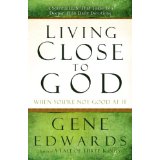
Living Close to God…by Gene Edwards

Living Close to God (When You’re Not Good At It) by Gene Edwards was written for the spiritually handicapped. Edwards describes the “spiritually handicapped” as those who struggle with intimacy in their fellowship with God, who falls asleep during prayer, who has a difficult time focusing during prayer, or someone who lacks the “spirituality” displayed in other Christians.

The chapters are short and the text is easy to read and understand—even a new believer would be able to grasp the exercises suggested. Edwards explains how learning to fellowship with God need not be limited to rigid devotional times, or lengthy eloquent prayers. One doesn’t need a college degree, a high-school diploma, or even be able to read. Edwards makes some intriguing points concerning the education level of most of Jesus’ followers in the Bible, notably that they were 98 percent illiterate.

Living Close To God makes several suggestions to aid the “spiritually inept” in their journey to experience Jesus and hear His voice. Consistent throughout the book was the importance of slowing down–slowing way down–and speaking words of praise to Jesus. Edwards also talks at length about repeating portions of specific Scriptures out loud to God, along with proclaiming one’s love for God, rather than focusing on prayers of request or personal need.  The author makes several useful suggestions that may help the reader “remember” to focus on the Lord for at least a few seconds every day.

I believe a new Christian would benefit most from this book, or perhaps someone who finds it easy to read/study things about God, but hasn’t developed an intimate relationship with Him. The person who seems to be too busy to slow down or the person raised in a legalistic environment who focused solely on “doing” may also find the tips in Living Close To God helpful.

The only problems I had with this book were of feeling pity for the author and the constant redundancy of the text. He stated many times how he had never been told how to experience Jesus on an intimate level while repeating the same “techniques” to aid in intimacy over and over again. I found it difficult to accept that he had never heard about praying Scripture before. Edwards also talked about the church not coming together to experience the presence of Jesus in this way, and I had to disagree with that. I’ve been to many churches that pray Scripture, encourage slowing down, being still, and listening to God.

Overall, I wouldn’t recommend this book to anyone I know mainly because my Christian friends already adopt the tips he suggested. As I mentioned before, however, it may be perfect for a new Christian or one who, like the author, has never been shown how to rest in God’s presence, listen to His voice, and spend time praising Him through word and song.

(I received this book for free from Waterbrook Multnomah Publishing Group and was not required to give a good review.)

God’s Love by R.C.Sproul

Who can begin to comprehend the depths and wonders of God’s immeasurable love? R. C. Sproul attempts to shed light on what is arguably the most misunderstood of all God’s attributes–love.

“Whatever God’s Love is, it is not exhausted by our concept of it. It transcends our best efforts to describe it. It is higher than our loftiest notions of it.” (God’s Love, pg. 29)

God’s Love is a penetrating theological read which challenges the intellect on a variety of issues and seeks to answer key questions: What is love? Is a loving God also a wrathful God? How is God’s love displayed through redemption, adoption, and election?

R. C. Sproul devotes an exceptional amount of time interpreting the doctrine of election. Lengthy Scripture quotes are also extensive throughout the text, eliminating the need to stop reading, pick up a Bible and look up references for clarification.

Of particular interest is the detailed exposition of the “love chapter”, 1 Corinthians 13. A great deal of God’s Love unravels the depths of truth woven throughout this often misquoted and misunderstood passage of Scripture. Readers may find this portion of text to be uniquely beneficial.

God’s Love is not a book designed for quick reading, or a cursory glance at the attributes of God. God’s Love provokes deep thought on deep doctrines and may be difficult to understand for a new Christian, or one who has not studied much of the Bible.

God’s Love is published by David C. Cook and available for purchase September 1, 2012.

Dr. R. C. Sproul is the President of Reformation Bible College and the Founder and Chairman of Ligonier Ministries. He has authored over 80 books including The Holiness of God, Chosen by God, and The Truth of the Cross.

A Little Inspiration from Isaiah

“Don’t fear anything except the Lord of the armies of Heaven! If you

fear Him, you need fear nothing else.”

Isaiah 8:13


“See, God has come to save me! I will trust and not be afraid, for the

Lord is my strength and song; He is my salvation. Oh the JOY of

drinking deeply from the Fountain of Salvation!”

Isaiah 12:2-3

“But the Lord of Hosts is exalted above all, for He alone is holy, just,

and good.”

Isaiah 5:16