What Does it Mean to be a “Healthy” Christian?

**Published in The Christian Online Magazine, October 2012**

What Does it Mean to be a “Healthy” Christian?

You can’t go very far without hearing the word “healthy”. It’s on every newsstand, magazine cover, and diet book. Ironically, these publications will claim to know the secret to becoming healthy, yet none of their articles will point to the same solution. How is a person supposed to know what direction to take?

As Christians we are admonished not to follow the patterns of the world (Rom. 12:1-2), but that doesn’t mean we shouldn’t concern ourselves with our physical health. Yet even more important than our physical health is our spiritual health. The more “in tune” we are to God’s Word, the more motivated we are to make wise decisions concerning our physical bodies. Physical and Spiritual cannot be separated. We are to honor God with our whole bodies, not just the pieces we want to give Him.

So, that leads us to the question—as a Christian, what does it mean to be “healthy”? I recently posted this question on Twitter and received some responses.

@Gregparker16 tweeted: “Being on your knees in front of the Lord every night.”

@Hasten_Home tweeted: “Functioning in full contact & strength in the capacity God intended.”

Both of these answers are excellent. But let’s take it a step further and find out what the most important Book has to say. After all, is there any better advice then what is found in the Word of God?

3 John 1:2 “Beloved, I wish above all things that thou mayest prosper and be in health, even as thy soul propsereth.” (KJV)

The best way to understand any verse is to go to the source of writing, that is, the original language. So much gets lost in translation. The Greek and Hebrew languages are very complex and many times a single word is given numerous meanings. So at all times one must consider the context of the passage when interpreting Scripture responsibly.

What we read in 3 John 1:2 is a typical greeting among brethren in the Church. Obviously they wished each other well, just as you or I would ask someone, “How are you?” Greetings such as these were acts of courtesy as well as genuine concern. What I found particularly interesting in this passage was the meaning of “health”. The Greek word “hugiēs” (pronounced hoog-ee-ace) translates: “uncorrupt” or “true in doctrine”. It also means “safe and sound” or “whole”.

And here lies the answer to our question. As a Christian, to be “healthy” is to be whole in spirit (including doctrine). Wholeness begins in our hearts.

We see this same concept displayed throughout Isaiah and Jeremiah. Several times the word “health” is used, and each time it refers to a spiritual wholeness for the sinful nation of Israel (see Jer. 30:17; 33:5-6, Isa. 58:8).

The most important health concern we have involves our spiritual health. A spiritually healthy, balanced Christian will make wise choices in the world, including that of food, activity, and finances.

God is in the business of restoration (wholeness). He often allows brokenness to bring healing—all to the glory of His Name. Psalm 51:8 “Make me to hear joy and gladness that the bones which thou hast broken may rejoice.” The Hebrew word for “bones” in this passage is not referring to the literal bone matter holding David together, but rather the spiritual matter. Translated from Hebrew the word “bones” means “substance of life”—in other words, his spirit. God allowed David to experience spiritual brokenness so He could bring David through the valley of repentance towards the mountaintop of restoration.

Do you want to be a healthy Christian? It begins with God’s word–obedience to it and cleansing by it. We don’t drive a car without first using our minds to get in the car, turn on the engine, and press the gas pedal. Likewise, we can’t expect to make wise life-choices in any area if our minds are not aligned with the absolute truth of God’s Word.

“I have chosen the way of truth…I will run to the path of your commands, for you have set my heart free.” Psalm 119:30, 32 (NIV)

© Rebecca Aarup

A Jesus Diet?

I didn’t grow up in a “fasting” household. I knew about fasting, but had never seen anyone practice it, much less preach about it. As an adult I’ve only been led to fast a handful of times, once for 3 days, and all the other times for only a day. A few days ago a friend of mine posted a link on her Facebook page to this site: www.40daystosaveamerica.com and I clicked on it. Immediately God impressed upon me the desire to do a 40 day fast while not only praying for our nation before the elections, but seeking a personal spirit of revival and repentance.

No matter what comes of the elections, or what side of the street we stand on concerning politics, I think we can all agree that the world needs revival—Christians need revival. This is something we can all be praying for in our own hearts and the hearts of our brothers and sisters.

Not everyone will be called to do a 40 day fast, and many will feel led to give up something other than food. I know some who are doing a Facebook fast, a coffee fast, or giving up other things and exchanging those wants for prayer. Fasting or not, earnest, sincere prayer is essential for the Christian.

And just in case I was feeling like maybe I heard God’s voice wrong (or even hoping I heard wrong!), I received the following devotional in my email this morning, which happens to be day #1 of my fast. It spoke directly to me, and I know you’ll be blessed by it as well. No matter what you choose to do for the next 40 days, I hope you will dive deeper into prayer for whatever God lays on your heart. This time will certainly not be wasted, as we know He saves every prayer for a future sacrifice of worship (see Every Prayer Uttered).

Blessings, my friends!

~Rebecca


A Diet in Jesus’ Name?
By Skip Heitzig

We focus a lot on food. Eating is one of our favorite pastimes, and we talk a lot about food. There are even place names that are foods. There’s Two Egg, Florida… Bacon, Delaware… Pancake, Texas… Hot Coffee, Mississippi.

One thing you don’t hear a lot about today is fasting. But did you know the Bible mentions fasting more times (nearly 60!) than even the “important” subjects like baptism?

Fasting is not a “diet in Jesus’ name.” It’s not a way to lose weight and be blessed. Fasting is done for spiritual motives.

In the Bible, fasting was done in times of danger, like when Esther was preparing to approach the king of Persia (see Esther 4). It’s a part of repentance: Both Daniel and Ezra fasted in response to the sins of the people, and the king of Nineveh ordered a fast when that city repented (see Jonah 3). Fasting was done in preparation for an important task or ministry. Jesus fasted 40 days and nights before He began His preaching ministry, and the apostles fasted before they sent Paul and Barnabas out (see Acts 13).

Fasting is a time when we take the focus off of ourselves, and put it on God and His will. (And that’s hard, in a culture where we worship self-reliance, self-determination, and self-worth!) Fasting reminds us that we belong to Him and that He owns us (see 1 Corinthians 6:19-20.). It’s a time when we discipline the body, and make our appetite our slave rather than our master.

In Matthew 6:16-18, Jesus speaks of hypocritical motives for fasting. Note that he says “when you fast,” not “if.” Fasting is not to be for some group in a monastery; it’s to be the norm!

Jesus’ point was that God never fails to notice fasting that is heartfelt and genuine, and that He will reward it. (Note: We don’t fast to gain God’s favor or “twist His arm” so He will do something!) But how would God reward a fasting saint? Through deeper intimacy with Him. By letting us know His will. By giving us clarity of understanding in a difficult situation, or a new strategy for ministry.

There are benefits to fasting (and here I’m going from less to more spiritual):

Fasting is good for our health. During a prolonged fast, the body lives on surplus fat. It renews the body and the mind. It helps the body control weight and dispose of wastes.

It teaches us self-discipline. Many of us are slaves to habits, but fasting makes desire our slave rather than being our master. It reminds us we can live without a lot of things. The prayer, “Give us this day our daily bread” will be more meaningful.

It helps us appreciate God’s gifts more. Fasting helps us feel our dependence upon God in this affluent, self-sufficient society.

It helps us see the needs of others: Going without food gets us in touch with people who live that way every day. That will make our prayer life more effective as well as activate us to help.

Fasting is always accompanied with prayer, and it will boost your prayer life. It’ll sharpen our praying—it changes the way we pray…and perhaps the results.

The pleasures of eating are fleeting, but the pleasures of fasting are lasting!

Copyright © 2012 by Connection Communications. All rights reserved.


Festering Wounds

Psalm 139:21-24

Festering Wounds

THOUGHT FOR THE DAY: “Search me, O God…point out anything in me that offends you.” Psalm 139:23-24 (NLT)

I’m a self-admitted Band-Aid fanatic. As a child I fainted at the sight of my own blood, so I learned to cover my wounds with Band-Aids, no matter the severity. It’s a habit that continued into adult-hood, despite being told it was “all in my head”.

Recently I had a surgical procedure to remove a tumor and after surgery I did what I always do, covered the wound with ointments and Band-Aids. In a matter of weeks the incision site was infected. I couldn’t understand why, after all, I had taken excellent care of it with creams and dressings.

A good friend of mine suggested I leave the incision uncovered, open to air. As much as I hated the thought of seeing my wound exposed every day, I gave it a try. Within days the incision began to heal properly.

About as much as I enjoy seeing my physical wounds, I enjoy facing my sin. But the only way it can be eradicated is with the healing air of the Holy Spirit. When I keep Band-Aids on my spiritual weaknesses, deep infections develop in my life and I have to rip off the blinders of denial to let God reveal diseases that need healing. This is the essence of inviting God to search my heart.

PRAYER: Make me uncomfortable with what offends you, Lord, healing my heart with your Spirit of truth.


When Darkness Prevails (Or at least tries to…)

“How could I have let this happen again?” Oh the irony of failure. In that moment, gazing at my cut up wrist while experiencing a tremendous load of excruciating personal pain I realized that even in this I had failed. Isn’t it amazing how Satan traps the thinking? The darkness is always easier to analyze once the light has returned.

I know it was spiritual oppression, the same haunts burdening me my whole life had returned. I thought I had been “free” forever of such troubles, but the reality hit—the depression, anxiety, and temptation to escape the hurt will probably always linger to a certain extent. The Enemy knows how to push my buttons–not to give him too much credit–but he’s pretty good at it.

Writing about this less than 24 hours later is risky, I recognize I’m opening myself up to a world of further rejection, but I know there is someone out there who understands my pain and this, my friend, is for you.

Sobbing on the couch the emotional torture continued. “What have I done wrong this time? Why am I not good enough for them? Why must I fail at everything? I’m not loved, I’m not accepted, and I never will be. I’m destined to be a lonely outcast.” The record played over and over and while most days hitting the “off” button is a no-brainer, this day was different.

I didn’t really want to talk to anyone. But I knew if I didn’t reach out I may do something worse. Maybe I would get it “right” next time. Sometimes being well studied in the Bible makes it even harder to push through such oppression. An extra measure of guilt rushes in, “I know better, I shouldn’t be feeling this way, this is wrong…etc.” Satan pounces on the opportunity to condemn the already condemned spirit.

I texted my mentor, who was at that moment the only person I felt I could trust. Though we had only known each other a short time I knew she would not judge me, condemn me, tell me I was crazy, or say she couldn’t relate to me.   She called me and said three words. Though it wasn’t an instant fix, it was exactly what I needed to hear from another human being.

“You are loved.”

I felt nothing close to being loved that morning–I felt rejected personally as a human being. I needed that jolt of reality from another Christian. “You are worth something. I don’t reject you. I love you. I appreciate you.”

So this post is not to tell you I have figured everything out, I’ve been cured forever, or that I know the secret answer for every suicidal or spiritually oppressive thought. I know the word of God is always the first answer, but beyond that, when the feelings overwhelm, having someone you can turn to– whom you can trust implicitly–is the next best option.

If you have such a friend, thank them for their presence and support in your life. If you don’t have someone in your life whom you can be 100% open with, pray that God would bring one to you. I prayed for such a person for several months, and God answered only weeks before my spiritual “relapse”. He knew what I needed, He saw what was coming, and He indeed made “a way to escape” that I could bear the pain (1 Cor. 10:13).

This post is also for the people who hide their pain from their Christian friends in fear of condemnation, judgment, rejection, or abandonment. We need community, we need relationship, and we need Christians who don’t shy away from the spiritual lepers like me.  I’m not perfect, I struggle too. I refuse to hide it. One of my biggest pet peeves within “church” is the lack of transparency. We need to be able to walk in to church and say “No, I’m not okay.” Or even, “I want to die.” And know that we will be supported, comforted, and helped. I’m not the only one out there. Or maybe I am? Either way, God has sparked a new desire within me—perhaps a new focus. I hope to help and encourage others as I’ve always tried to do, but even more so, inspire others to live transparently. Trust me; there is someone out there who could be helped by you if you’d only be real about your struggles.

Let’s join together and stop pretending we’re walking on clouds all of the time. This is life, it’s real. No one is on cloud nine 100% of the time—even if they are a Christian. Ask God if there is someone in your life who simply needs to be told they are loved, appreciated and wanted as a human being. You never know how God could use that to lift someone out of a pit of despair.

Tools of the Trade–Mirrors or Hammers?

On the heels of an amazingly extravagant weekend celebrating my daughter’s 5th birthday came blowing in the whirlwind of rejection. Don’t get me wrong—our weekend in Disneyland and California was fantastic; wonderful memories were created and I’m sure my daughter will remember it for the rest of her life–as will I. But the joy was tainted by a letter of “rejection” received just a few moments ago. And while I knew this was a possibility, and it’s not the first “rejection” I’ve received, it stings nonetheless.

Satan uses one rejection to bring up memories of others—people rejection, publisher rejection, performance rejection…etc. Feelings of rejection began early in my childhood. I was a heavy kid with bad acne so the attention I got was not the kind I wanted. I learned how to be a people pleaser very early so I could receive at least some positive reinforcement. Everyone likes to be happy, right? So I went out of my way to help the people around me be happy. It’s what I wished someone would have done for me.

All weekend long I had been thinking about a recent “people-rejection” situation in my life. I prayed over it continually and asked God to help me move past it. Just as I was getting “over it” I received a letter of rejection from a publishing company. Another gut blow.

Satan uses people and circumstances in our lives to assault us with a common “theme”. The theme assaulting me throughout my life is “you are rejected” and “you are not loved”. Even though I do my best to “live peaceably with all men”, trying  to recognize and acknowledge my faults, apologizing, trying to make amends, and continuing to encourage others, I find I am still misunderstood more often than not. My intentions are questioned and my motives are doubted. Through all of this is the same message, “you’re not good enough and nothing you do or say ever will be good enough”.  Over the years these feelings catapulted me into severe depression, physical self-abuse, and even attempted suicides.

I have since learned to ask God to show me how to deal with these feelings biblically (What can I learn? How can I allow God to change me through this situation?). I also ask God to prevent me from being used as an instrument of negativity in someone else’s life, because we are all being assaulted with a message from our Enemy. I do not want to be used by Satan to deliver a message to someone that they are not good enough, loved or appreciated, or whatever the message may be. I realize that many times I have been this “tool” and I continually ask God to open my eyes and eliminate these occurrences from my life.

Perhaps God is calling you to the same area of self-examination. You see an individual  or think of them and immediately have unpleasant thoughts. Maybe you think they’re out to get you, out to hurt you, or that they’ve rejected you. If you feel this way you may be dealing with un-forgiveness. Ask God to help you deal with these people as He would have; treating them as you wish they would treat you (Matthew 5-7).

And if you are battling rejection either relationally or circumstantially, ask God to help you deal with those feelings biblically. It may be tempting to retaliate against such people—wanting them to feel the way they make you feel by ignoring them, sending hate mail, “unfriending” them from social media and the like, but there is a reason God has allowed it and you will never grow spiritually in that area if you pretend like it isn’t a problem. When we fail to see people (or circumstances) through the eyes of Jesus, we will likely face similar situations again and again until we learn to deal with them appropriately. God never gives up on us or teaching us His ways, and I am thankful for that even if it hurts!

Whatever you are feeling today, whatever messages your Enemy has tried to send you or use you to send others, God wants to help you recognize and combat them with His word of truth. If no one else ever understands or accepts you, God does. He will never leave you, forsake you, reject you, misunderstand you, or ignore you.

So, the next time you’re tempted to react a certain way, ask God if you’re being His tool, or a tool of the Enemy in that situation or person’s life. What messages are you delivering with your words and actions? I recently read something and it’s a good thought to end on:

“If my life was the only source of God someone was introduced to, what conclusions would that person make of God’s character based on my reflection of Him?”

In other words, is my God a God who rejects, withholds love, criticizes, assumes the worst, and condemns, or is my God a God who forgives unconditionally, displays compassion, and gives grace? Am I a hammer or a mirror?

“The Lord is gracious and righteous; our God is full of compassion.” Psalm 116:5

“In the same way, let your light so shine before men, that they may see your good deeds and glorify your Father in heaven.” Matthew 5:16


No Way Out But Through by Graham Aitchison

Mental illness, spiritual warfare, addiction, bullying, rage, hopelessness, physical sickness, abuse, emotional torture–Graham Aitchison divulges the deepest secrets of his life’s journey with startling transparency in No Way Out But Through.

Anyone who has experienced the pain of the above mentioned issues will find themselves nodding in agreement as they read Graham’s story. The text is refreshingly real—as if you are sitting in a living room listening to the author tell you his story first-hand. It’s rare that a book is written from the view of “sharing” rather than “preaching”. Along with the “realness” of the authors journey is a manuscript packed with spiritual truth.

I found this to be a fascinating read once I got into the meat of the story. So much of Graham’s life reflects my own struggles with mental illness. Often the journey through mental/emotional sickness leads one into isolation, misunderstanding, and intense loneliness, but knowing others have suffered as you have brings great comfort. Even for the reader who has not experienced such things, there is much to learn from No Way Out But Through. Graham’s book provides a resource for the confused family members and frustrated friends of those who do deal with these issues. All around it’s a book many people could benefit from.

What I found most interesting was Graham’s discussion of Christianity and mental illness. No doubt this is a subject of much debate in the Church today leaving the mentally distressed guilt-ridden and most everyone else critical of such “mental” experiences.

“Throughout everything I was learning to break through, there was one essential factor to the whole process that I became more and more aware of over time – the great love and endless patience that God has for people, especially those who struggle with any form of mental illness.”

Graham acknowledges the spiritual warfare at play within his mind as well as how God brought him through overwhelming, debilitating darkness. Much of his journey to healing started with honesty within himself and before God. Many of the points he makes throughout the book remind me of what I learned in the 12-step programs I’ve been through. I especially appreciated his conversation regarding change within the heart rather than change in one’s circumstances.

“Change for the better starts from within, and will then eventually be followed by external change – not the other way around. We will never solve our own problems through trying to blame others for what are actually our own responsibilities, nor will we solve our problems through continued disregard of our own emotions and hearts, and through listening to an increasingly shallow and self-serving society.”

“Modern society in many ways tells people to look for peace and happiness in external circumstances, hence the abundance of consumerism. Christ’s way of thinking, which He passes on to those who follow him, encourages the individual to seek out true, lasting peace and understanding through looking honestly into the mirror and journeying with God through the parts of themselves they would rather avoid.”

Admittedly not everyone will relate to Graham’s story, but plenty of people will relate or know someone who can.  If you’ve ever wondered what goes on in the mind of someone suffering with mental illness such as depression, obsessive compulsive disorder, severe anxiety, anger, or bullying, then you will learn much from Graham’s story. No Way Out But Through reads like a journal–raw and real.

“God’s way of thinking is a total contradiction to the world’s way of thinking. The world’s way of thinking encourages dishonesty, shallowness, irresponsibility and pride. God’s way of thinking encourages honesty, depth, personal responsibility and humility.”

Thankfully, this is exactly what Graham has done—spoken with depth, honesty, responsibility and humility.

For a limited time you can purchase Graham Aithchison’s book, No Way Out But Through from Amazon.com for only $2.99. Click HERE to buy the book now.

(I purchased this book with my own money and did not receive it in exchange for a good review. The opinions expressed here were my own.)


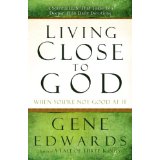
Living Close to God…by Gene Edwards

Living Close to God (When You’re Not Good At It) by Gene Edwards was written for the spiritually handicapped. Edwards describes the “spiritually handicapped” as those who struggle with intimacy in their fellowship with God, who falls asleep during prayer, who has a difficult time focusing during prayer, or someone who lacks the “spirituality” displayed in other Christians.

The chapters are short and the text is easy to read and understand—even a new believer would be able to grasp the exercises suggested. Edwards explains how learning to fellowship with God need not be limited to rigid devotional times, or lengthy eloquent prayers. One doesn’t need a college degree, a high-school diploma, or even be able to read. Edwards makes some intriguing points concerning the education level of most of Jesus’ followers in the Bible, notably that they were 98 percent illiterate.

Living Close To God makes several suggestions to aid the “spiritually inept” in their journey to experience Jesus and hear His voice. Consistent throughout the book was the importance of slowing down–slowing way down–and speaking words of praise to Jesus. Edwards also talks at length about repeating portions of specific Scriptures out loud to God, along with proclaiming one’s love for God, rather than focusing on prayers of request or personal need.  The author makes several useful suggestions that may help the reader “remember” to focus on the Lord for at least a few seconds every day.

I believe a new Christian would benefit most from this book, or perhaps someone who finds it easy to read/study things about God, but hasn’t developed an intimate relationship with Him. The person who seems to be too busy to slow down or the person raised in a legalistic environment who focused solely on “doing” may also find the tips in Living Close To God helpful.

The only problems I had with this book were of feeling pity for the author and the constant redundancy of the text. He stated many times how he had never been told how to experience Jesus on an intimate level while repeating the same “techniques” to aid in intimacy over and over again. I found it difficult to accept that he had never heard about praying Scripture before. Edwards also talked about the church not coming together to experience the presence of Jesus in this way, and I had to disagree with that. I’ve been to many churches that pray Scripture, encourage slowing down, being still, and listening to God.

Overall, I wouldn’t recommend this book to anyone I know mainly because my Christian friends already adopt the tips he suggested. As I mentioned before, however, it may be perfect for a new Christian or one who, like the author, has never been shown how to rest in God’s presence, listen to His voice, and spend time praising Him through word and song.

(I received this book for free from Waterbrook Multnomah Publishing Group and was not required to give a good review.)

Have You Seen ME?

Suggested Reading: Job 42:1-7

Thought for the Day: “I have seen you, and I loathe myself and repent in dust and ashes.” Job 42:5


I admit it; sometimes I don’t approach the throne of God with fear. Sometimes I get complacent. Sometimes I get indifferent. Sometimes my prayers begin with a “Hey, God” or “Jesus, I really need you to do…” and it’s not long before I’m getting nothing but silence. My prayers seem to bounce off the rubber ceiling.

Familiarity can produce a casual attitude. I see this in my human relationships. The more comfortable I am with someone, the more likely I am to approach them with a “Hey there” or “Can you do this for me?” But a human relationship is far different then a divine relationship.

As I read through the latter chapters of Job, I am reminded of God’s power, sovereignty, control, and awesomeness in relation to me, the creation. Who am I to approach the throne of God with such callousness? Is God my friend? Yes. Is God my companion? Yes. But he is still God.

When I’m faced with the reality of God versus the reality of myself, I have no choice but to fall on my face, loathe my state of sin, and repent. It’s so unbelievably tempting to walk through the day with pride. It’s so easy to think I’m doing okay, and God can be proud of me, His good little child. But that is a deception of the highest form.

God is proud of me as his creation, not because of anything I have done.

Job was about as righteous as they come, but after three chapters of verbal chastisement from the Holiest of Holies (see Job 38-41), Job was left on his face in repentance. He had seen God.

Today, I am humbled as God gives me a glimpse of His righteousness. Who am I but a lowly servant of the greatest King! God owes me nothing—I owe Him everything.

“I owe no one anything. Everything under the heaven is Mine.”—God (Job 41:11)

Egg-White Fury

Suggested Reading: Job 6:1-10

“This, at least, gives me comfort despite all the pain-that I have not denied the words of the Holy God.” Job 6:10 (The Living Bible)


The more things pile up the easier it is to react poorly in an insignificant situation. When my bank account is empty, my loved one is sick and the doors I wanted to go through have been slammed in my face-all at the same time-I get cranky. All of a sudden I’m irritated when my cats look at me funny.

The casualty of this inner war is unfortunate to be at the wrong place at the wrong time and receives the blunt force trauma of my egg-white fury.

I think of all the times I snap at my spouse (poor guy), curse at a jar I can’t open, or fly into a rage over a glass of spilled water. These are gross over-reactions to minor inconveniences. And through the lens of Job I see what went wrong. I allowed the greater surrounding circumstances in my life to dictate my behavior in the smaller situations.

So what do I take away from Job’s gag reflex? As much as he complained, as distraught as he was, as horrific his circumstances were, he was still able to say he did not deny the words of God. He remained faithful to his convictions despite insurmountable opposition.

I’d like to be able to say the same thing. I’d like to be able to experience difficulty without needing to release my anger on other people. I’d like to say the worst reaction I ever had was gagging over an egg-white. I’m not there yet, but God hasn’t given up on me.

The Challenge

“The law shall be his constant companion. He must read from it every day of his life so that he will learn to respect the Lord his God by obeying all of his commands. This regular reading of God’s laws will prevent him from feeling that he is better than his fellow citizens. It will also prevent him from turning away from God’s laws in the slightest respect.” Deut. 17:19-20 (The Living Bible)

I recently read an article in InTouch magazine (Dr. Charles Stanley) about a woman who cut apart and re-bound her Bible into 4 sections to help her read through it easier. Admittedly, holding the Bible in my hand and thinking about reading through the whole thing-cover to cover-seems rather daunting unless it’s divided into little bite-sized pieces over the course of a year.

Thinking what a fantastic idea this woman had, I was also convicted about my own scattered reading plans. God spoke to me there and challenged me to read from Genesis 1:1-Revelation 22 in one week. No, that wasn’t a typo, I said one week. My first thought was, how will I ever find time for that? But God is bigger than my excuses and quickly brought to mind many things I could give up for one week to accomplish this goal.

Taking on this challenge has been one of the best experiences I’ve encountered in God’s word. Reading through the books in order has opened my eyes to things I’ve never understood before. Stories are making more sense read in context. And by context I don’t mean the 12 verses surrounding one verse, but the books surrounding other books. For instance, many people (including myself) avoid the book of Leviticus. Granted, it’s not the “easiest” read, but is important since “the whole Bible is given to us by inspiration from God and is useful to teach us what it true and to make us realize what is wrong in our lives; it straightens us out and helps us do what is right.” (2 Tim. 3;16-The Living Bible)

There was something so inspirational and special about reading the Bible continuously. I can’t adequately describe it other than to recommend doing it.

I wrote a 30-day Bible reading plan (understanding very few would be able to devote a week to it) and am challenging you, my friends and lovers of the Word, to ask if God would have you do this. It is a challenge, I won’t say it’s not. Prayerfully consider if God would have you do this or perhaps adapt the plan to suit your needs.

The average reader can easily accomplish this goal in 2-3 hours per day. I’ll list some tips I’ve employed to help me read the word in one week that will help you read it in one month. You may want to consider using a different version than you normally study from in order to provide a new experience. I chose a paraphrase (The Living Bible) so it reads more like a novel. This is for reading, not studying, so don’t get too hung up on the translation.

1-Get up an hour earlier or go to bed an hour later. (It’s only one month-a worthy sacrifice indeed.)

2-Listen to the Bible on audio while you drive, cook, clean, shower, etc. You’ll find there’s a lot of time for your ears to be working while your hands are busy.

3-Avoid the temptation of social media-the articles, cutesy pictures, posts, statuses, and other time-consuming reads. You’ll find those things add up quickly. 5 minutes here and 5 minutes there is an hour before you know it. In an hour you could have read several chapters in the Bible.

4-Give up the news or other programming you consistently watch on television. Even one or two shows is an hour or more that you could be reading.

5-When you are reading the Bible at length you will discover things you want to look up and research. Avoid the bunny trails! Keep a note-pad handy and write down the verse/subject so you can study it at a later time, once you’ve reached your reading goal.

6-Finally, don’t read just to read! Read the Story to grow in your relationship with Jesus and ask Him to open your eyes to new things each and every time you begin. He will answer that prayer and your eyes will surely be opened more than you’d ever imagine.

I can’t wait to hear your testimonies and pray you will be encouraged and strengthened in your journey. Who knows, maybe you’ll like it so much you’ll decide to do it a couple times every year. I know I’ve been inspired to do as much. Please let me know in the comments if you are going to be taking this challenge so I can be sure to pray for you!

Through the Bible in 30 Days

Day 1: Genesis 1-40

Day 2: Genesis 41-Exodus 30

Day 3: Exodus 31-Numbers 3

Day 4: Numbers 4-Deuteronomy 8

Day 5: Deuteronomy 9-Joshua 15

Day 6: Joshua 16-1 Samuel 7

Day 7: 1 Samuel 8-2 Samuel 17

Day 8: 2 Samuel 18-2 Kings 12

Day 9: 2 Kings 13-1 Chronicles 29

Day 10: 2 Chronicles 1-Ezra 4

Day 11: Ezra 5-Job 11

Day 12: Job 12-Psalm 10

Day 13: Psalm 11-51

Day 14: Psalm 52-92

Day 15: Psalm 93-133

Day 16: Psalm 134-Proverbs 14

Day 17: Proverbs 15-Ecclesiastes 12

Day 18: Song of Solomon 1-Isaiah 32

Day 19: Isaiah 33-Jeremiah 6

Day 20: Jeremiah 7-47

Day 21: Jeremiah 48-Ezekiel 31

Day 22: Ezekiel 32-Hosea 14

Day 23: Joel 1-Zechariah 5

Day 24: Zechariah 6-Matthew 28

Day 25: Mark 1-Luke 14

Day 26: Luke 15-Acts 10

Day 27: Acts 11-Romans 16

Day 28: 1 Corinthians 1-Galatians 6

Day 29: Ephesians 1-2 Timothy 4

Day 30: Titus 1-Revelation 22