Discerning the Devil’s Voice: Who is Satan?


One of the most important aspects of fighting spiritual warfare is the ability to recognize Satan’s voice when we hear it. And by voice I am not referring to an audible sound that resonates through our ear canal and bounces off our ear drum. I’m referring to a thought strategically placed in our minds. The same place where our own thoughts originate, like, “I want pizza for lunch,” or “I’m tired, I think I’ll take a nap.” (Click here for a more in-depth discussion on the Voice of the Flesh)
Satan’s voice: Incomplete truths, deceptions, schemes, tricks, lies, temptations, partial Scripture quotes taken out of context to support a view that is opposed to God (see Matthew 4:1-11).

Satan’s Bio

Liar:
“He was a murderer from the beginning and has always hated the truth. There is no truth in him. When he lies he is consistent with his character; for he is a liar and the father of lies.” (John 8:44, NLT)

Did you catch that important phrase? When he lies he is consistent with his character. In other words, it is impossible for Satan to tell a complete truth. Maybe he can spew some half-truths, but as we know, a half-truth isn’t really the truth. It is a lie or a deception. Just as God can only act according to His character (holy, loving, just…etc.), Satan can only act according to his character (lie, deceive, accuse…etc.).

Destroyer:
“The thief’s purpose is to steal, kill, and destroy.” (John 10:10, NLT)

Any thought Satan (or his demons) place in your head has this purpose, to destroy you, steal from you, or kill you (physically or spiritually). While Satan cannot snatch us from our Father’s loving hand (see Romans 8:38-39), he can render us spiritually dead, or ineffective for the cause of Christ. Nothing pleases our enemy more than seeing us stumble around in a fog of confusion over our purpose and place as children of God.

Powerful Controller:
“The world around us is under the power and control of the evil one.” (1 John 5:19, NLT)

We know from passages like Job 1 that Satan is limited in power to only what God has allowed him to have. So we need not have an exceptional, hysterical fear over what Satan and his minions can do. However, we should take note of and respect the power that he does have over world forces. Why else would Satan be able to offer Jesus the kingdoms of the world (see Matthew 4:8-9) if they did not belong to him? He controls the world (as God allows)—albeit temporarily. Nevertheless, until Jesus returns and sets up His kingdom on earth, binding Satan for a thousand years, we will continue to see the work of the devil not only in our own lives (as he tempts us, speaks to us, accuses and oppresses us) but also in the world systems controlled by unbelievers.

Deceiver:
“Satan, which deceiveth the whole world: he was cast out into the earth, and his angels were cast out with him.” (Revelation 12:9, KJV)

One of Satan’s chief purposes is to deceive. Of course, one of the subtleties of deception is the deceived usually don’t recognize that they’re being deceived—hence the term, deception! If we think it will be easy to detect demonic influence, we are wrong. It won’t always be easy, and once Satan sees in our behavior that we are on to his schemes, he will try new ways to trick us. This is one of the reasons why putting on the armor of God daily is imperative to our spiritual health.

Life is not a joke to Satan. He knows what the Bible says, in fact, having been around for thousands of years we can be certain he knows the Bible better than we do. He knows what it says about his future, and he knows what it says about us, as God’s creation. We have authority over Satan, and he knows it. Rest assured, he’s not looking at us and laughing it up. A book I read recently says this: “Satan has you in his cross-hairs, and he’s not smiling.” He wants to destroy us in any way possible.

So, the first step in recognizing Satan’s voice is in understanding what his character is. When you hear “thoughts” you can test them against what we’ve already discussed (God’s Voice, the Flesh, or Satan) and see which voice the thought seems to line up with. For example, one thing I often hear, almost daily, is a thought that goes something like this, “God can control everything, and yet He is allowing this to happen. He’s not listening to your prayers anymore. He gets pleasure in seeing you suffer.” Sometimes it is easy to entertain such thoughts because there is partial truth to them. (God does indeed control everything and certainly could stop whatever is happening even though He has chosen not to.) However, it’s not enough to ignore these thoughts—we must rebuke them and reinforce the truth in place of that lie. If we fail to take this step, we are only leaving ourselves open to new attacks of a similar nature. (More will be discussed on this in the next post.)

I’m sure you can think of similar thoughts too. What sort of deceptions has the enemy consistently hounded you with over the years, either through your own thoughts or the words of others?

Still have questions? Check out these posts for more:

Is Spiritual Warfare real?

What’s the difference between the flesh and Satan?

Can Satan’s influence affect children?

**If you enjoyed this post and others, please take a second to enter your email address into the space provided on the right hand side of the computer screen (or scroll to the bottom of your screen if using a smartphone) and you will receive new posts in your email inbox. This is absolutely free and your information is never shared!**

_____________________________________________________

profilepic3Rebecca Aarup has written devotionals/studies/articles for a variety of publications including The Secret Place (Judson press), Evangel (Light and Life Communications), and Mustard Seed Ministries. She just released a new Bible Study The Word: Six Lessons from Psalm 119 which is available as a free download on her website or in print form from Amazon. Beyond writing, Rebecca is a wife, home-schooling mom, and Bible student at Liberty University. She lives in Glendale, Az with her husband Chris and 5 year old, Samantha.  You can read more from Rebecca by subscribing to her blog (it’s free) and following her on twitter and facebook.

The Voices in My Head: The Flesh (Part 2)

In the last post I gave a simple example of how to discern the voices in our head (God, Satan, or the Flesh). In this post I will elaborate more on the Flesh, which is probably where the greatest confusion remains in most Christian circles. First, the following is a simple way to define the voices:

God’s voice: The Bible as a whole, God’s Word, Truth, the Holy Spirit’s leading (always in line with God’s written Word).

Satan’s voice: Incomplete truths, deceptions, schemes, tricks, lies, temptations, partial Scripture quotes taken out of context to support a view that is opposed to God (see Matthew 4:1-11).

The Flesh: Learned behavior/habits, coping mechanisms, our own subjective thoughts (i.e. “I want to eat at Burger King today).

You would be hard-pressed to walk into any church today and hear a message teaching these concepts, which is dreadfully sad. Most Christians walk around with somewhat of a self-defeatist attitude. “I’m just a wretched sinner!” True, we are sinners saved by grace (Eph. 2:8-9), but once we have been saved we are a new creation (2 Cor. 5:17, Gal. 6:15, Eph. 4:24, Col. 3:10) clothed with the righteousness of Christ (Who I Am in Christ). We are no longer wretched sinners, but rather, children of God who still sin.

splinter1-150x150

     Neil Anderson uses an excellent illustration of this concept (from the book The Bondage Breaker). When you get a splinter in your finger, do you say you are a wretched piece of wood because you now have a splinter in your finger? Do you now take on the identity of the splinter as your own? Obviously not! No, you are a human being with a piece of wood in your finger. Scripturally you will find this concept made clear in Romans 7:14-25. It doesn’t take much work to discover that Paul is referring to himself after he has been regenerated (I know much debate remains about this fact, but if you’re using proper techniques of Biblical interpretation you can arrive at no other conclusion than this). Many of us can identify with Paul’s struggle. We know better, yet we still sin! What’s wrong with us?

The Flesh

     In simple terms we are infected with the “sin splinter” otherwise known as “the flesh”. The nature we were born with (self-serving/pride) along with the habits we’ve developed over a lifetime all contribute to this voice known as the flesh. Paul recognized this and he hated it. He knew he had been regenerated as a new creation in Christ, yet at times he still struggled to put that old nature to death. We can only imagine what Paul’s specific struggle was with but Scripture isn’t clear on it. It wouldn’t surprise me if pride had something to do with it, though. Deep down we are all struggling against a self-serving attitude, from the way we dress to the food we eat. Our world revolves around us, our desires, wants, and needs. No matter how awesome we are as Christians, pride will always be an issue because it is in our flesh which continuously wars with the new life we received when we accepted Christ. Jesus is the antithesis of pride and self. This is why just doing “what Jesus would do” is not as easy as it sounds. It contradicts our flesh! On our own we can’t will ourselves into good works with proper motives; this can only be accomplished through Christ’s rule in our hearts.

Coping Mechanisms/Habits (Flesh)

     As an addict I learned how to cope with mental anguish by abusing drugs. This was a learned behavior, as well as a sinful behavior. Over time it became a pattern of life. Feel pain—take drugs—pain goes away (temporarily). Some of us deal with unhealthy learned habits every day when we fight the urge to over-indulge at the dinner table or eat chocolate for dinner instead of broccoli (maybe even chocolate covered broccoli?). I grew up drinking soda and cool-aid every day, and eating macaroni and cheese and bologna sandwiches. It was a learned way of eating (and an early introduction to weight problems). As an adult I have had to work hard to re-learn a healthier way to treat my temple (1 Cor. 6:19-20). But when that voice kicks in saying, “Boy, I’d sure love to sit down with a bag of Doritos and watch T.V. all day,” I can be certain this voice is my flesh and not Satan.

Defense Mechanisms (Flesh)

•denial (a conscious or unconscious refusal to face the truth)

•fantasy (escaping the real world)

•emotional insulation (withdrawing to avoid rejection)

•regression (reverting to less threatening times)

•displacement (taking out frustrations on others)

•projection (blaming others)

•rationalization (making excuses for poor behaviors)

[Strongholds] are fleshly thought patterns that were programmed into your mind when you learned to live your life independently of God. Your worldview was shaped by the environment you were raised in. But when you became a Christian, nobody pressed the “CLEAR” button. Your old fleshly habit patterns of thought weren’t erased.¹

I hope this clears up some of the confusion surrounding the flesh and what exactly it means. In the next post we’ll discuss Satan’s voice in specific detail.

     Are you able to recognize fleshly patterns in your own life? What is your greatest “flesh” struggle?

_______________________________________________________

¹ The Bondage Breaker ©1990/1993/2000 by Neil T. Anderson Published by Harvest House Publishers (pp. 60-61)

_______________________________________________________

Related Posts:

The Voices in My Head: God, Satan, or My Flesh (Part 1)

Satan, God, the Flesh, and Spiritual Warfare

Spiritual Warfare 101: Is it Real?

Before Your Feet Hit the Floor: An Essential Daily Prayer

PrayerWarrior

“Father, thank you for the provision you have made for victory over Satan. Now, by faith, I put on the girdle of truth. May my life today be motivated by truth. Help me to maintain integrity. By faith, I put on the breastplate of righteousness. May my heart love that which is righteous and refuse what is sinful. Thank you for the imputed righteousness of Christ. By faith, I put on the shoes of peace. Help me to stand in Christ’s victory today. Help me to be a peacemaker and not a troublemaker. By faith, I take the shield of faith. May I trust you and your Word today and not add fuel to any of Satan’s darts. Thank you that I can go into this day without fear. By faith, I put on the helmet of salvation. May I remember today that Jesus is coming again. Help me to live in the future tense. Protect my mind from discouragement and despair. By faith, I take the sword of the Spirit. Help me to remember your Word and to use it today. Father, by faith I have put on the armor. May this be a day of victory.”


Wiersbe, Warren –The Strategy of Satan

Spiritual Warfare 101: Is it Real?

shieldoffaith

Spiritual warfare is real, whether you believe it or not. If you think I’ve gone off the deep end with my theology, consider the following evidences (I’m going to assume if you’re a regular reader of this website that you believe the Bible to be the true, infallible word of God):

•The Lord of Hosts

You can scarce read the Old Testament without running into the phrase “Lord of Hosts” (using the King James Version, anyways). The name “Lord of Hosts” in the following Scriptures all have the same Hebrew meaning, and there were dozens more I didn’t include for reasons of time and space.

“As for our redeemer, the Lord of Hosts is his name, the Holy One of Israel.” Isaiah 47:4

“Again the word of the Lord of Hosts came to me.” Zechariah 8:1

“The Lord of Hosts is with us.” Psalm 46:7

“Therefore thus saith the Lord of Hosts…” Jeremiah 23:15

“Hear ye and testify in the house of Jacob, saith the Lord God, the God of Hosts.” Amos 3:13

The word “hosts” (tseb-aw-aw’) is derived from the root word meaning assemble, fight, perform, or war. The term “Lord of Hosts” can be translated “The Lord of Armies” or “The Lord of War”. He is an active God of the ARMIES! Why do you suppose the term “Lord of Armies” would be included in the Bible, at least a hundred times in just the Old Testament, if it didn’t mean exactly what it says, that God leads an army? What exactly is an army used for? Battle!

The battle is so real, the people and prophets of God referred to their Leader as the divine captain of the largest host of armies ever amassed (Isaiah used the term “Lord of Hosts” more than thirty times in his book). Our Lord is not passive, He is active and fighting a very real, very serious spiritual war. So why aren’t we?

•The Apostles (After the Cross)

Paul (and the other apostles) had a godly view of spiritual warfare. Paul often spoke of principalities, powers, forces, spirits, Satan, the enemy, the battle, and other “spiritual warfare” terms. He spoke of it as if it were a fact, a reality, a real issue the Church needed to be aware of. (I’m purposely not mentioning the work of Jesus here [casting out demons…etc.] which will be discussed in later posts.)

“For I am convinced that neither death nor life, neither angels nor demons, neither the present nor the future, nor any powers, neither height nor depth, nor anything else in all creation, will separate us from the love of God that is in Christ Jesus our Lord.” Romans 8:38-39

“For our struggle is not against flesh and blood, but against the rulers, against authorities, against the powers of this dark world and against the spiritual forces of evil in heavenly realms.” Ephesians 6:12

“His intent was that now, through the church, the manifold wisdom of God should be made known to the rulers and authorities in the heavenly realms.” Ephesians 3:10

“Resist the devil.” James 4:7

“Be sober, be vigilant, because your adversary the devil, as a roaring lion, walketh about, seeking whom he may devour.” 1 Peter 5:8

“And there was war in heaven. Michael and his angels fought against the dragon, and the dragon and his angels fought back. But he was not strong enough, and they lost their place in heaven. The great dragon was hurled down—the ancient serpent called the devil, or Satan, who leads the whole world astray. He was hurled to the earth, and his angels with him.” Revelation 12:9

•Noema

It doesn’t get more straight-forward than this, friends. Noema (no-ay-mah) is the Greek word for “mind”. Consider these uses of this specific form of the word noema:

“If there was anything to forgive—I have forgiven in the sight of Christ for your sake, in order that Satan might not outwit us. For we are not unaware of his schemes (noema).” 2 Corinthians 2:10-11

“In whom the god of this world hath blinded the minds (noema) of them which believe not.” 2 Corinthians 4:4

“Casting down imaginations and every high thing that exalteth itself against the knowledge of God, and bringing into captivity every thought (noema) to the obedience of Christ.” 2 Corinthians 10:5

Did you notice anything interesting? The same Greek word, noema, is used in three different passages of the same context—how Satan directly influences the minds and thoughts of people, believers and non-believers alike. Another definition of noema is perception. In other words, it is a satanic perception of circumstances that influence us toward unforgiveness (2 Cor. 2:11), and a satanic perception of circumstances which blinds the minds of unbelievers against the true knowledge of Christ (2 Cor. 4:4), and also a satanic perception of events that infiltrate the minds of believers which can lead them into sinful behaviors (2 Cor. 10:5).

Satan is real, his influence is real, and the battle we face every day is real. God is fighting, his angelic armies are fighting, but are we as the bride of Christ fulfilling our role in this area (see Eph. 3:10)? Why aren’t we talking about this in our churches, teaching this in Sunday Schools, and hearing this from our pulpits? Perhaps the greatest deception of all is the belief that no “battle” exists, and if it does, I certainly don’t need to get involved. After all, didn’t Jesus defeat the enemy at the cross?

Well, if that is what you have believed I pray your eyes will be opened now to see the dangerous “perception” of that thinking. If you’re not fighting, Satan is gaining ground in your life. As I pointed out in the above section “After the Cross”, all of those Scriptures were written for believers after the death and resurrection of Christ. Obviously, we still have a battle to fight.

Now it’s your turn. What role do you actively take in spiritual warfare? Do you believe it is important? Why or why not? Is it an easy battle for you? On a scale of 1-10 (1 being the lowest, 10 being the highest) how would you rate your daily participation and awareness of spiritual warfare?

As the scales begin to fall from your eyes and you take a more active role in fighting Satan’s schemes (noema), you will face more spiritual (and physical) opposition, I can guarantee it. Write the above verses down, keep them with you and memorize them, because you will need the truth to fight. Without the truth, you are defenseless and will be rendered an ineffective, unarmed soldier.

________________________________________________________

In my next post I’ll be discussing the voices in our head (the Holy Spirit, Satan, and our Flesh) and how you can recognize what voices are coming from where (remember, Satan quotes Scripture too!). If you need to catch up on what all this spiritual warfare talk is about, check out my last post. If you haven’t already, please take a moment to subscribe to this blog (it’s free and your information is not shared) in the space provided on the upper right hand area of this web page so you can receive future posts. I look forward to getting to know you and hearing what your battles in the spiritual realm have been like. Comments are encouraged (however, insults, personal attacks and foul language will not be allowed on this website).

First time here? Learn more about me here.

Satan, God, the Flesh and Spiritual Warfare

If you read my recent post (So, What is YOUR Word) you already know that my 2012 was defined by “perseverance”. To elaborate further, the perseverance revolved primarily around spiritual warfare (consider one of my most popular posts this year: Freedom is Here). Yes, there were health issues, financial issues, and relational issues, but the biggest issue was Satan. (And no, I’m not saying “the devil made me do it”.)

I didn’t kick off the New Year asking God to give me a new word; I had already learned my lesson from 2012. However, God has clearly given me a new focus: spiritual warfare. Perhaps the appropriate “word” would be: fight.

Let’s be honest here, you probably aren’t reading too many articles about spiritual warfare, Satan, and his evil spirits, are you? Neither am I. So my mission in 2013 is to change that. After all, there are plenty of people writing about relationship problems, financial woes, and health issues. There are plenty of people writing awesome devotions and providing good soul-food to inspire and encourage. And for the majority of 2012 I also wrote about a variety of things from devotionals to health and fitness to marriage. This year I am choosing to focus on what I’ve learned and experienced regarding Satan, spiritual warfare, freedom and truth, so I can really help someone live in the spiritual abundance they were created for (as well as keeping myself well grounded). Step one involves identifying the problem. So in my next post (and many more to follow) I will address some of these questions:

Is there an Enemy?

What does he sound/look like?

What is the difference between the flesh and the devil?

How can I recognize God’s voice over my own desires?

Is Satan really messing with my mind on a daily basis?

Are there really spirits out there trying to control me?

If I am a Christian, aren’t I immune to demonic power?

Should I address spiritual warfare with my child, and if so, how?

I hope you’re well-armored, because the more you know about the schemes of the devil, the more opposition you can expect to encounter. This isn’t for the faint of heart. This is serious, this is life or death.

I’m going to share a passage I read and pray with my daughter every morning before we start our day (she is five years old).

“Put on all of God’s armor so that you will be able to stand safe against all the strategies and tricks of Satan. For we are not fighting against people made of flesh and blood, but against persons without bodies—the evil rulers of the unseen world; and against huge numbers of wicked spirits in the spiritual world. So, use every piece of God’s armor to resist the enemy whenever he attacks, and when it is all over, you will be standing up.” Ephesians 6:11-13

If you’ve subscribed to this blog because you enjoy my devotionals and other articles, don’t worry, I share all of my favorite Christian influencer blogs/articles/devotions every day on twitter and my facebook author page, so if you’re on either of those services and are following me, then you are already receiving great soul-food material from great Christian authors every time they post something new. (Authors like Beth Moore, Joel Rosenberg, John and Stasi Eldredge, and many more, along with some “lesser” known names whom I’ve stumbled across in the writing world and whom have a great voice for truth.) I also host an online women’s ministry which shares a great deal of inspirational/devotional material from women all over the world. My social networking sites are used primarily for the spreading of truth from other great writers to make transforming teaching readily available to you at your convenience. I will also continue to post articles I have published in other periodicals here on this website, along with the occasional book review (again, another way I like to share truth from the voice of other believers), as well as information about my upcoming book releases.

Buckle your seat belts and hang on to your Bibles, this ride is about to get bumpy!

Book Review: Question Everything by Tyler Ellis

question everythingQuestion Everything by Tyler Ellis is a book like no other (watch the book trailer HERE).  Initially I was struck by the detailed format, and as a writer myself, overwhelmed with the amount of work and research that must have gone in to creating such a well thought out masterpiece.

When I first opened Question Everything, my thoughts went something like, “This is it?” But as I read through the questions I gradually realized how brilliant this was. What will you find on the pages of this book? Questions! A LOT of questions! Specifically there is an obersation-type question for each verse in the New Testament.

At first you might be wondering what place such a book has on your shelf, and admittedly I wondered that myself, but as I dug in to the text I started to understand the author’s intent more and more. The point is to ask questions about what you’re reading, and uncover the answers yourself. This is precisely why the author does not include his own answers. Those answers are for you to discover. Rather than read a book that tells you what a verse means, you can go to the source (the Bible) and do the work yourself. Instead of trusting everything you hear/read from other writers and theologians, you can dig in yourself.

Second Timothy 2:15 encourages us to study to show ourselves approved unto God, workers that are not ashamed and who rightly divide God’s word. What better way to do that then to walk through the words of the New Testament, one by one, and really ask questions about each verse?

I’m a Bible student and am used to the study of Scriptures, asking questions, and uncovering the answers, but this book is different then anything I have ever seen in college or church. While I have spent a great deal of time studying passages, or even individual words within a verse, I have never gone through every verse in the New Testament, one by one, and asked myself a relevant question about it. It is a great resource for the well-trained Bible student or the new Christian. It is even a great book for someone searching for the truth. Really, anyone could benefit from it. What a great idea, I wish I had thought of it! (But I do not envy the work that had to have gone into it.)

I look forward to getting a print copy so I can work through it with my daughter, whom I home-school. I know this will be a great addition to her Bible studies!

(I received Question Everything by Tyler Ellis for review purposes only and was not required to give a positive review. The opinions expressed here are strictly my own.)

_________________________________________________________

Tyler Ellis is the author of“Question Everything: A fresh way to read the best-selling book of all time.  He serves on staff with Newark Church of Christ as a Campus Minister at the University of Delaware. He’s also an advocate in the cause of ending Bible poverty.  Hear more from Tyler on his blog, Facebook and Twitter.

Refusing to Back Down: What it Really Means to Speak the Truth “In Love”

Refusing to Back Down: What it Really Means to Speak the Truth “In Love”

On the heels of yet another heated political debate the tweets, status updates, and blogs are running full steam. I would certainly be no exception to this. On the other hand, though, there are many Christians who feel it is offensive to openly talk about their political views or their beliefs on touchy subjects such as homosexuality and abortion. This proverbial “duct tape” silences many well-meaning believers, especially in the world of writing, where platforms and likeability are ranked high on the author’s list of things to succeed in.

No doubt, this is a controversial topic. To speak or not to speak: that is essentially the question. For me the answer came in the form of another question. Do I care so much about getting “likes”, “follows”, and “subscribers” to build my platform that I keep quiet about such topics? What is more important, speaking the truth or being liked?

I live in a state where people have been arrested for holding Bible studies in their homes. Refusing to allow and even prosecuting such acts of religious expression is becoming more common in today’s world. Am I to look the other way when things like, say, who will become the next president would directly affect issues of religious freedom? I’m not convinced that speaking the truth “in love” or having my words “seasoned with salt” means to keep silent. But let’s look at the Bible– because I am human and maybe I am wrong. If so, I want to allow God to correct me and keep me on His path to truth.

First of all we have Jesus and the Sermon on the Mount. The things Jesus said were highly offensive, especially to the Pharisees who were the most “spiritual” people of that time. They knew how to follow all of the rules and live about as perfect as a sinful person could possibly live. But Jesus wasn’t impressed because He saw their hearts. He called them out on their hypocrisy and warned the crowds of listeners not to be like them. I really can’t think of anything more offensive then calling someone out in front of other people, pointing out their faults, and warning the audience not to be like them! But—Jesus was, well, Jesus! As God living and breathing in a human body, He had the right and lived the life to back up His words of truth. I don’t have that luxury. I’m not perfect, I am not God. I cannot see someone’s heart, so publicly calling someone out is probably not a form of expression God has called me to partake in. (And under this light, I am aware of some instances where I have sinned in this area.)

But then we come to Paul. Now, the Colossian Church had become infiltrated with false teachers, and Paul, led by the Spirit of God, stepped in and spoke up about a controversial topic: false teaching. In this same letter to the church he says, “Let your speech be always with grace, seasoned with salt, that ye may know how ye ought to answer every man. (Colossians 4:6)” Several verses in the Bible have been taken out of context to support erroneous practices, and this is probably no exception. It has been used over and over again as an admonition to keep quiet about important issues. In the context of the passage, however, that is absolutely not what Paul is saying. In fact, in the previous three chapters Paul warns the church about following the philosophies of man and the patterns of the world (2:8) while at the same time pointing the congregation to the Solution to their problems (2:9-3:1). Now that is what it means to speak the truth with love and grace.

The difference between condescending pious gibberish and sincere warning in the nature of love and concern come out of a sincere heart focused on the One who has given abundant life as well as freedom from the bondage of evil entanglements.

So what does all of this mean? As Christians we have a responsibility to speak the truth, to always be ready with an answer for the hope that dwells within us. When I stand up and say why I believe one candidate it a better choice for America, I am doing so out of love for my country and the people in it. I do not want to see our religious rights taken away. I want to be able, for instance, to hold a Bible study in my home without fear of retaliation. If one candidate can provide that, then I am going to talk about it. In the same regard, if one candidate is clearly supportive of the dangerous deception that a “woman’s right to choose” or a woman’s right to kill her baby is more important than the life growing inside that woman, as a Christian I have a moral responsibility to speak up for the unborn who cannot speak for themselves. I haven’t always done this, and I live every day with the regret of my silence and what became of a situation where I refused to speak. Never again will I make that mistake.

I think an important distinction in all of this is the delivery used to convey our messages. Are we saying things like, “If you vote for so and so you’re an evil demon of darkness” or are we saying, “I believe so and so is a better candidate because…” One of these expresses a view with respect and dignity while the other bashes on those who would hold a different opinion. I can’t find any example where Paul put down the character of another believer because of the choices they were making, no matter how poor those choices might have been. Instead, I see a great man of God who desperately wanted people to understand the truth, and understand where the truth comes from—Jesus. Paul always, always, always pointed people to Christ. I know I have failed in this area many times (and I confess it to God), but that is my ultimate goal in all I say and do.

I will not apologize for my views because they stem from personal convictions. On the other hand, I want to keep me speech grace-full, making sure to avoid name-calling and character bashing of those who would disagree with me. In the end, for me, I feel it is more important to be real with people rather than sensor my beliefs in the name of “likeability”. Do I want to be a successful author with a large platform to reach others with the message of Hope? Of course I do! But I will not compromise the truth in the form of silence. This is a critical time for our country, and we cannot afford to exchange silence for popularity. Yes, I want to have integrity in all I say and do, especially in a public outlet. But I also want people to know I am a real person, with real struggles, real opinions, and real convictions. Maybe I’ll lose a few “fans” along the way, but ultimately I will be the only one held accountable for my choices. In that regard, God’s opinion of my words and actions are all that really matters.

How about you? Have you experienced backlash in your efforts to speak the truth in love? How has God used your experiences in approaching touchy subjects to teach you how to speak in a grace-full way? Have you every failed in this area of “seasoned” speech? Do you feel it’s more important to convey a certain public “persona” then it is to convey your personal convictions? I look forward to your responses and hope to learn from what God has taught you through your experiences.

Red Letter Revolution by Shane Claiborne and Tony Campolo

Red Letter Revolution by Shane Claiborne and Tony Campolo could be aptly described as the Red Letter Revolution Movement’s manifesto of sorts. The text is written out as a dialogue between Tony and Shane, explaining their views/beliefs regarding a wide assortment of topics from racism, abortion, church history, liturgy, and much more. All of these tied in to what they call the “Red Letter Movement”–a group of self-described radicals who believe the keys to living are found solely within the red letters of Christ found in the Gospels.

I was initially interested in the book based solely on the title. What Christian doesn’t want to live out the “red letters” of Jesus? An unbelieving world would likely view a sold-out Christian as being radical, so that term alone didn’t resonate negatively with me. Unfortunately, I didn’t get far into the text before disappointment set in. While I didn’t mind the dialogue-type format, I did mind the modern slant and somewhat “new-age” overtones sprinkled throughout the text. I was also quite disappointed in the lack of Scriptural evidence used to back up any of the author’s opinions. Perhaps I was to simply trust their words as truth.

Not wanting to make a rash judgment, though, I stuck with the book as long as possible, but in the end I could not finish it. Certainly my opinion is not a reflection of the authors’ character, as I believe their faith to be wholly genuine and heartfelt. I have no doubt they mean what they say, and live what they believe in an active way.

Most Christians would agree that no one is a judge of the heart except God. It is very possible that there are genuine believers amongst all faiths. What I don’t ascribe to, however, is the need to adopt the practices of various faiths which differ from my own. In the chapter “Dialogue on Liturgy”, Shane talks extensively about reciting certain prayers along with the benefits of using prayer beads. His suggestions, though well-intentioned, set off alarm bells for me. His argument is mostly based on the “works” of many catholic saints and nuns—their works being an outward display of a genuine love for Christ. I have nothing against Catholics, Mormons, Methodists, or anyone else. But I cannot agree with being good (as in doing good deeds) as a sole evidence of genuine faith. A lot of people do great things in the world, but they do not really know Christ. I believe that type of thinking is dangerously erroneous. Tony goes on to say,

“Spiritual disciplines, which include liturgical practices, are requirements for those who are committed to living out the red letters of the Bible. Such disciplines keep us focused on Christ and facilitate our surrendering to an infilling of Christ’s spirit.” (pg.40)

The last thing I need is more practices and procedures to prove to the world I am who I say I am (Christian). Should I cross myself before I pray as well? Will that give me more of the Holy Spirit? I’m sorry, but I do not need beads, books, or regulatory prayers to ensure I am communicating appropriately with Jesus. This is not a judgment against those who do use these things—it’s just not for me. Furthermore, I have no knowledge of such disciplines being a requirement for the filling of the Holy Spirit, and don’t appreciate the implication that I cannot be a “red letter” Christian or filled with the Spirit unless I adopt such practices.

Overall the tone of this book comes across (to me) as very worldly, new aged, and mystical. I would not recommend this book to anyone, unfortunately. My suggestion for someone wanting to live out the life and words of Jesus is to study the Bible—all of it. Not just the red letters, but the black letters of the Old and New Testaments. Surrendering to Christ is the real beginning to reflecting His character. If one wants to study beyond the Bible, I would encourage that person to seek doctrinally sound material and to weigh any books/study guides against the authority and accuracy of Scripture.

Red Letter Revolution is published by Thomas Nelson and available for purchase on Tuesday, October 9, 2012.

**I received Red Letter Revolution from BookSneeze in exchange for my honest review. I was not required to give a positive opinion–and all of the sentiments written here are strictly my own.**

Every Prayer Uttered


“Each one had a harp and they were holding golden bowls full of incense, which are the prayers of the saints.” Revelation 5:8

(Suggested reading: Revelation 5:1-14)

Psalm 56:8 tells us that God holds every tear we’ve shed in a Divine bottle. He hears every sob; He takes into account every painful moment we’ve experienced. We’re also told in Revelation that God has another Divine container—a bowl. This bowl preserves every prayer uttered by every saint from Adam to the end of time.

When we praise Him in worship, when we thank Him for our meal, when we cry out in anguish over our sin—every single utterance is preserved for a culminating moment in history.

Just imagine, all the host of heaven is gathered around the throne of the Father. Jesus, at the right hand of the Father, holds the Scroll sealed with seven seals. He alone stands worthy to reveal its contents. This knowledge causes all of heaven to bow in worship,

“You are worthy to take the scroll

and to open its seals,

because you were slain,

and with your blood you purchased men for God

from every tribe and language and people and nation.

You have made them to be a kingdom

and priests serve our God,

and they will reign on the earth.”

Revelation 5:9

As this proclamation thunders throughout heaven, the four living creatures and twenty-four elders fall before the Lamb, pouring out a sweet smelling sacrifice of incense. This sweet smell, this glorious offering is poured out at the feet of Jesus. Your prayers, my prayers, our ancestor’s prayers, the prayers of every martyr, and the prayers of every biblical “hero” now becomes a sacrifice of worship. Not one of them is wasted. No, not one.

Every prayer uttered is an offering–an offering now and an offering to come.

Worthy is the Lamb both now and forever, Amen.

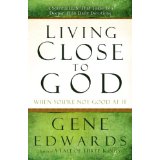
Living Close to God…by Gene Edwards

Living Close to God (When You’re Not Good At It) by Gene Edwards was written for the spiritually handicapped. Edwards describes the “spiritually handicapped” as those who struggle with intimacy in their fellowship with God, who falls asleep during prayer, who has a difficult time focusing during prayer, or someone who lacks the “spirituality” displayed in other Christians.

The chapters are short and the text is easy to read and understand—even a new believer would be able to grasp the exercises suggested. Edwards explains how learning to fellowship with God need not be limited to rigid devotional times, or lengthy eloquent prayers. One doesn’t need a college degree, a high-school diploma, or even be able to read. Edwards makes some intriguing points concerning the education level of most of Jesus’ followers in the Bible, notably that they were 98 percent illiterate.

Living Close To God makes several suggestions to aid the “spiritually inept” in their journey to experience Jesus and hear His voice. Consistent throughout the book was the importance of slowing down–slowing way down–and speaking words of praise to Jesus. Edwards also talks at length about repeating portions of specific Scriptures out loud to God, along with proclaiming one’s love for God, rather than focusing on prayers of request or personal need.  The author makes several useful suggestions that may help the reader “remember” to focus on the Lord for at least a few seconds every day.

I believe a new Christian would benefit most from this book, or perhaps someone who finds it easy to read/study things about God, but hasn’t developed an intimate relationship with Him. The person who seems to be too busy to slow down or the person raised in a legalistic environment who focused solely on “doing” may also find the tips in Living Close To God helpful.

The only problems I had with this book were of feeling pity for the author and the constant redundancy of the text. He stated many times how he had never been told how to experience Jesus on an intimate level while repeating the same “techniques” to aid in intimacy over and over again. I found it difficult to accept that he had never heard about praying Scripture before. Edwards also talked about the church not coming together to experience the presence of Jesus in this way, and I had to disagree with that. I’ve been to many churches that pray Scripture, encourage slowing down, being still, and listening to God.

Overall, I wouldn’t recommend this book to anyone I know mainly because my Christian friends already adopt the tips he suggested. As I mentioned before, however, it may be perfect for a new Christian or one who, like the author, has never been shown how to rest in God’s presence, listen to His voice, and spend time praising Him through word and song.

(I received this book for free from Waterbrook Multnomah Publishing Group and was not required to give a good review.)